
I left my laptop in to be repaired today, which was a pretty smooth operation until I realised I don’t know the French word for hinges. All this means that I’m currently typing this on an AZERTY keyboard.
From QWERTY to AZERTY
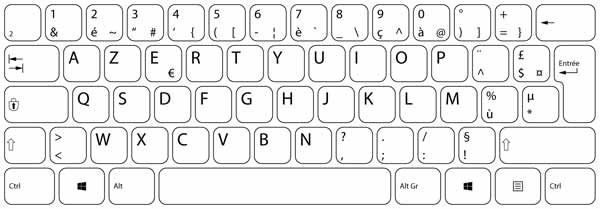
I left my laptop in to be repaired today, which was a pretty smooth operation until I realised I don’t know the French word for hinges. All this means that I’m currently typing this on an AZERTY keyboard.

You may have noticed yesterday, that I wrote the following, ungainly looking thing:
blond(e)
Why put the E inside parentheses, some of you might have furiously asked? Or perhaps you slammed your fist on the table and angrily wondered why I even bothered including the E at all. Well, as always, I had my reasons, because blond and blonde are in fact two distinct words.

Recently a student was trying to think of the word umbrella. They knew the French word (parapluie), but that didn’t help them to remember or figure out what the English word is. And as I thought about the word umbrella, I completely understood why: it actually has nothing to do with rain at all.

I saw IT last week, only it was actually Ça, considering I saw it in a cinema in Liège. English-language films are generally dubbed here, but as it was a somewhat arty cinema, they were proud to offer the VO (version originale) with French and Dutch subtitles. Having two sets of subtitles taking up space on the screen is quite distracting, but it’s an interesting opportunity to compare English, French, and Dutch at the same time.
Watching a film with subtitles in a language you know is always a little odd, as they never translate things exactly, largely because such a thing is basically impossible. Even so, there are always one or two choices the subtitler makes which boggle the mind. I don’t recall anything like that in this case, but there was one necessary difference in translation that intrigued me.

Learning any language is never easy. It takes a lot of time, and patience, and practice. But above all, it requires mental readjustment. And that’s the part that a lot of people find the most difficult.

Strange can be a strange word. If I asked you to explain it, you’d probably have no problem. It means weird, unusual, not normal. Easy.
Now though, think of words related to strange.
You can probably think of strangely, stranger, and estranged. OK, strangely is the adverb form of strange, but what’s the link with the other two words?

Yesterday, I mentioned that I expect other languages to have an increasing influence on English due to the fact that there are more non-native speakers of English in the world than native speakers. I’ve already noticed this happening a lot with one specific word. Let’s see if you can guess what it is:
 English-Language Thoughts