Teacher, can I say…?

This is the beginning of one of the most common questions English teachers get asked. And the answer is usually, Well, it’s technically correct, but we never actually say that in English. Which in turn is usually met by frustrated sighs. For all the language’s flexibility, we often fix on only one of the many possible ways to express an idea. This is often a tremendous source of frustration for learners, especially if they’re feeling pleased about using a certain grammar form, only for their teacher to tell them what they’re saying doesn’t really sound natural.

Often, this stems from direct translation from one’s mother tongue. In French for example, it’s standard to use nouns to refer to feelings. For example: Continue reading
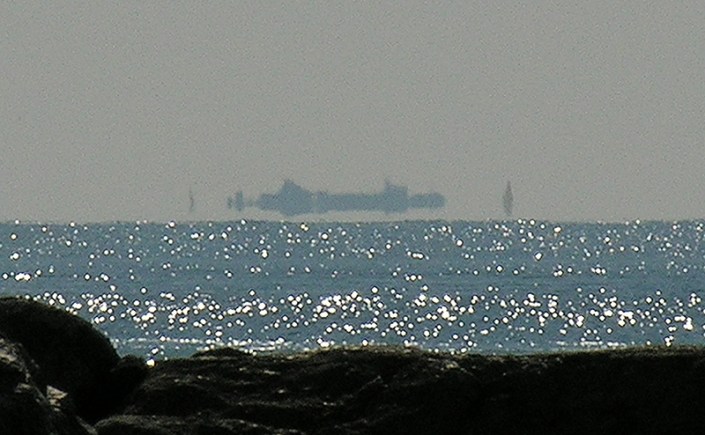
Fata Morgana

I came across this word today while I was online. I’m not sure how I got to it, as my wanderings around the internet can be quite aimless, but something brought me to a list of Werner Herzog films, and seeing mention of his 1971 film reminded me of the term.

If you’re not familiar with it, it’s simply a fancy way to refer to a mirage. More specifically, it was originally used to refer to a specific type of mirage which can often be observed in the Straits of Messina between Sicily and mainland Italy. The name is the Italian translation of Morgan Le Fay, sorceress/witch/fairy half-sister of King Arthur in British legend. The effect was so named because people believed that the illusions they saw were her castle in the sky. And looking at this recent example from China, you can understand that: Continue reading

S: the Story of a Letter

If you’re a native English speaker, you probably don’t think about individual letters too often. Why would you? You use them pretty much automatically. So if I asked you to talk about the letter s, you might not have much to say. But for people who have to learn English, it’s quite important, and can prove to be a tricky little customer.

The first area of confusion is with plurals. Most languages don’t add s to make a plural, like English does, so it can be very hard for speakers of those languages to remember to add the s. Even when some languages do add an s, it’s in a slightly different way. Portuguese and Spanish, for example, often add an s to a noun to make it plural. But, they also add an s to adjectives describing those nouns, leading a lot of Portuguese and Spanish speakers to do the same thing in English. French is similar, but the s is generally silent, meaning that a lot of French speakers don’t pronounce it even if they write it.

But the most common area of error is with third-person singular verbs. That might sound like gibberish, but let me demonstrate: Continue reading

My Left Hand: a Sinister Tale

I hope you appreciate how lucky you are to be right-handed. Of course you might actually be left-handed, in which case my apologies for the assumption, but statistically you’re probably right-handed. You’re also probably right-footed (90% of right-handers are also right-footed, and about 50% of left-footers). You might not have been aware that footedness is a thing. If sports involving kicking balls don’t occupy a position of any importance in your life, the concept may not have occurred to you. If you’re not sure which is your dominant foot, go kick the nearest person in the shin with each foot (not simultaneously, you don’t want to get hurt) and see which one hurts them more.

I’m entirely lopsided: both left-handed and left-footed. I was quite proud of this when I was a child. I felt it made me stand out. As a football fan, I was impressed by how left-footed players like Ryan Giggs always seemed to be so quick and dynamic and creative. My footballing career did not quite follow his trajectory, mind you. But mostly I just liked being different from everyone else. And I still do. But as I got older, I began to realise that it wasn’t so easy being left-handed… Continue reading

Campaign Supernova

I’ve encountered the word campaign so often later (generally preceded by presidential), and then, last week, I found myself camping for a few days. And I wondered: camp/campaign: are they related somehow? And how was it that the word campaign is so similar to words for countryside like campagna (Italian) campagne (French, and no Autocorrect, I didn’t mean champagne)? An investigation was in order, so down the etymology rabbit hole I went… Continue reading

You are Where you Live

Acoustic adaptation is a theory in naturalism which suggests that the sounds animals make adapt to their environment: either as a result of their physical environment, or other sounds around them. You can notice that in cities, for examples, were birds will often seem to mimic the man-made sounds they hear every day. Recently though, some linguists have suggested that human languages undergo a similar process of adaptation.

Though this theory have yet to be conclusively proven, there are some intriguing ideas behind it. The main principle believed to affect the sound of a language is the frequency sound waves can travel at in a particular environment. For example, consonants don’t travel well in areas of dense vegetation such as rainforests, and therefore languages which developed in such landscapes are light on consonants and feature long vowel sounds with lots shifts in tone. Continue reading

Pullman

This might be the least Italian-looking and -sounding work you’re likely to come across. I first heard it quite a few years ago. Some Italian students I was teaching were using it while speaking to each other. Intrigued, I asked them what it meant, and they told me that it meant coach, as in a comfortable bus for long journeys. Unable to resist finding out why such an unassuming English surname would be the Italian word for coach, I investigated. Continue reading