Divided by a Common Language

England and America are two countries divided by a common language – George Bernard Shaw

When you’re here, let’s speak American – Sarah Palin

George Bernard Shaw, of course, was Irish, which just goes to show how confusingly international the English language can be. While there are a number of national and regional variations of English around the world, the greatest division between forms of English is that between American English and British English. Most other forms of English tend to be largely a variation, or mix, of one of these two, with varying influences from other languages of that country.

There are two main areas of difference between British and American English. The first is vocabulary, with different words being used to describe the same thing: cookie/biscuit, tap/faucet, vacation/holiday, hood and trunk/bonnet and boot, lorry/truck, and the whole fry/chip/crisp fiasco. The second is of course spelling. Two of the main changes are: words ending in -re in British English changing to -er in American English, and -our changing to -or.

It’s quite easy to live with these changes, and they tend to cause little confusion for native speakers (except for the occasional Briton who goes on holiday to America and asks for a burger and chips). And yet, people can get very passionate about these differences, and defensive of their English. I think a lot of that can be attributed to simply preferring the way one has always done things, and instinctively resisting any alternative to that. I think almost all of us have that instinctive resistance to change to some extent, and a sense that our way is unquestionably the right way. However, I think that when it comes to language, there’s a little more to do it than that.

I think that the English we use is also inextricably bound up with our national or cultural identity. And why not? We use it every day to communicate our thoughts, and it can be a clear signifier of where we’re from. Look at how American English differs from British English. Looking at it objectively, it certainly seems more logical. English pronunciation can be notoriously confusing, due to its origins in, and borrowings from, other languages. Changing -re to -re, for example then, just makes the spelling of words closer to how they’re pronounced. And with words like colour and flavour, is that u really necessary? No? Get rid of it then. It’s understandable that a new country, conscious of setting out on their own in contrast to their former coloniser, would like to establish its own identity. Language is an easy thing to change, and is an obvious sign of difference. In addition, the ideals of the Founding Fathers were strongly influenced by the Enlightenment ideals of logic and reason, and it makes sense that in creating a uniquely American form of English, they would try to impose some logic on the language. It’s a modern, forward-looking form of English, not relying on using old forms simply because they’ve always been used.

As for why some people seem to resent American English? I think it’s partly just resentment at the new form of English, daring to make a change. But also, the UK is very old compared to the US, and has accrued a lot more traditions. One can observe many seemingly archaic rituals and institutions in relation to government and the monarchy. And one can look at British English as a similar institution. Does it make sense that words that end in -re sound like -er? Not anymore, but then how on Earth could one imagine changing the spelling of a word that’s existed for so long? Logic and reason are all well and good, but sometimes you just have to accept things as they are and work with it. I don’t think that’s a uniquely British attitude by the way, but rather a more general European one. So many of our nations are so old, and we’re so often reminded of our history, that we can be resistant to change. Plus, the cultural exchange common in a small continent with many differnet countries means that different languages influence each other, and we get used to the fact that some of the results of these influences might not seem so logical. So why simplify things then, when we’ve learned to live with language’s eccentricities?

I should state for the record, by the way, that being Irish, my English is mostly British English, with a lot of influence from the Irish language. As a result, I do instinctively prefer the conventions of British English, and when I see American English spellings my brain does tell me that they’re wrong. And yet I use some Americanisms, like, for some reason, the way I pronounce yoghurt. So I think that gives me a little objectivity in comparing the two forms of English. And I suppose the way Hiberno-English can incorporate some American English reflects the nature of Irishness. We’re culturally and geographically very close to the UK, but we’ve long felt an affinity with the United States, largely due to the numbers of Irish people who emigrated there, and we’re very exposed to and influenced by American culture.

George Bernard Shaw might have been joking when he made his pronouncement about British and American English, but there is some truth to it. Some things can get lost in translation, but at the same time, whatever variety of English we speak, we still speak the same language, and despite the many differences, that still unites us. Still, be careful if you go to England and tell someone that you like their pants.

Image: https://idea-udl.org/conferences/past-conferences/london-new-york/
 

Derny Look Great?


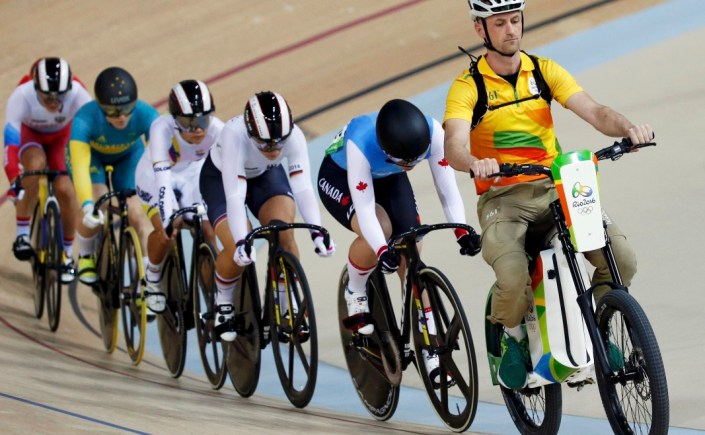
Every four years, at least once while watching the Olympics, I’ll have a look at the schedule for the day, I’ll come across a sport listed and ask The what??? Keirin!? What on earth is that!? It seems that with every Olympic Games my vocabulary widens thanks to names of specific forms of sports I’ll never encounter again in my life. So here’s a quick look at some of those oh-so specific terms we’ve been hearing for the last week and a bit:

Keirin: a type of cycling race in which the riders sprint after a few speed-controlled laps in which they have to follow a man on a motorized bicycle called a derny. When I see the derny rider, I always think: Who is he? Does he only ever ride a derny? What does he do with the rest of his time? I don’t think I could do that, help people win glory without having a chance myself. Also, it looks really silly.

Repechage: a stage in a competition in which competitors who failed to proceed to the final round, usually by a small margin, get another chance to qualify. It sounds much nicer than losers’ round, but then when you consider the original meaning in French—fishing out/rescuing—the name sounds deliberately humiliating.

Shuttlecock: Hee hee! The little thing they hit around in badminton. Shuttle coming from the meaning to move quickly back and forth, and cock from its resemblance to a male bird’s plumage (and nothing else).

Fosbury Flop: The method employed by high jumpers to go over the bar backwards. Popularised by American athlete Dick Fosbury in 1965. Before he introduced his technique, athletes used a variety of forward-facing methods, all of which looked incredibly undignified, and can be seen in video below:

Laser Radial: Not a classic sci-fi novel, but a class of sailing boat, seemingly so-called because it sounds cool. And why not?

Corruption: sadly, there are probably too many words to cover here, so I’ll have to do another list of Olympics-related corruption vocabulary.

Punctual to a Point

While thinking about the word punctuation today (which is the kind of thing I do), I considered how similar the word punctuality is to it. I wondered what the link could be. It seemed to me that the concept they share is exactitude. Punctuation allows one to be precise in their meaning in a sentence, and if one is extremely punctual, one allows arrive at the exact moment one should.

And unsurprisingly, both come from the same root word: punctus, the Latin word for point. Which makes a lot of sense. Punctuality, though is an interesting concept. Of course it’s a positive one that we value, overall. We hate if our friends are late when meeting up (if we’re normal).  But do we ever admire it? Like the person who never misses a day off work through sickness, are we really impressed by someone who’s never late? Or does it annoy us? Do we think they’re too perfect, too punctilious? I think is why punctuality is often invoked as a kind of back-handed compliment in that great bastion of reading-between-the-lines: the job reference. Continue reading

The Heat is on

It’s that time again, as every four years we’re glued to the TV to watch the Olympics. I always loved it, especially the track and field events. But one word that I’ve always found a little strange is: heat. As in, a qualifying race for a final. Where does it come from?

It seems that the word was first recorded with this meaning in the 17th century, then being used to refer to a run to prepare a horse for a race. Or warm it up, if you will.

For a lot of the more elite athletes, it pretty much has the same meaning: to warm up, generate some heat, for the final.

I hope you’re all enjoying the Olympics: I’ll be spending most of time trying to figure out the name of the exact shade of green the diving pool has turned.

100

First, let me say a big thank you to every one of you reading this. Yesterday I got a lovely notification to tell me I that reached gained 100 followers on WordPress. Which was a lovely surprise. As I’m writing about quite an uncool, niche topic, and just sharing my own thoughts every day, without really planning things, I didn’t expect to attract too many followers. And yesterday was also my first time with over 100 views, which was a nice little instance of serendipity. These numbers may not be so big in the grand scheme of things, but I appreciate everyone who takes the time to read blog, so I’m delighted for every single person who follows me.

So if you’re reading this, and enjoying it, thank you so much, and I hope to keep your mind occupied with mindless trivia about this beautiful language. Continue reading

3 Days 3 Quotes | Day 3

First, let me say thank you one last time to Fatma at https://aminfatma.wordpress.com/ for nominating me; I encourage you all to visit her site before you continue reading.

One last time, here are the rules:

  1. Thank the person who nominated you .
  2. Post a quote for 3 consecutive days ( 1 quote for each day )
  3. Nominate three new bloggers each day.

To end the challenge, I knew I had to go with my favourite author, and some of the best, most practical advice about writing in any format: Continue reading

Muckanaghederdauhaulia

The above is the longest place name in Ireland, and is obviously quite a mouthful. It’s an Anglicisation of the original Gaelic name Muiceneach idir Dhá Sháile, which, as you all know, means “pig-shaped hill between two seas.” Most modern placenames in Ireland are similar Anglicisations. For example, many Irish towns begin with Bally- or Balli-, coming from the Irish word Baile (town) being part of the original name. A town like Ballycastle would have originally been name Baile an Chaislean (town of the castle).

Such Anglicisation can lead to redundancy. This is often the case with rivers, as many of them begin with Owen-, from the Irish word abhainn, meaning river. So Abhainn Buí, meaning the Yellow River, was translated to the River Owenboy.

Some pretty ordinary sounding placenames have such origins, but some can be a bit of a mouthful due to some clumsy translation: Continue reading