I amn’t, am I?

 I am not  I’m not  I’m not  Am I not?  Aren’t I?
 You are not  You’re not  You aren’t  Are you not?  Aren’t you?
 (S)he is not  (S)he’s not  (S)he isn’t  Is (s)he not?  Isn’t (s)he?
 We are not  We’re not  We aren’t  Are we not?  Aren’t we?
 You are not  You’re not  You aren’t  Are you not?  Aren’t you?
 They are not  They’re not  They aren’t  Are they not?  Aren’t they?

Spot the odd ones out?

I’ll give you a little time… Continue reading

Awfully Kind of You Old Chap

terror.png

Figure 20 for Charles Darwin’s The Expression of the Emotions in Man and Animals (1872). Caption reads “FIG. 2. – Terror, from a photograph by Dr. Duchenne.”


If someone gave us a choice between having an awful meal or an awesome one, we probably wouldn’t hesitate in making our decision. 300 years ago, however, we may have taken our time. While the difference between the two in modern-day English is immediately evident, things were not so clear-cut in the past. The root word for both awesome and awful is awe, which is now generally considered to be a positive condition, but was until relatively recently more flexible. Awe was a concept much considered by the Gothic and Romantic writers of the late 18th and 19th century. It was defined as a feeling or reverence, admiration or fear, or a combination of the above in the face of the sublime: that which is so elevated beyond the ordinary, so transcendent, that the only natural response is awe.

Continue reading

Riding the Nightmare

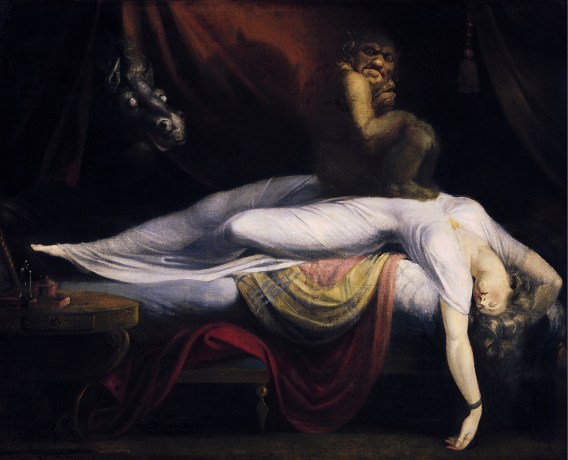
John_Henry_Fuseli_-_The_Nightmare.jpg

The Nightmare Henry Fuseli 1781


How many nightmares can you spot in the famous painting above?

Nightmare is quite an everyday word. It has the most common meaning of a bad dream. But a situation or a task can be a nightmare, and many a footballer’s ‘ad a ‘mare on the pitch.

If you compare it to dream, it’s a rather strange-sounding and looking relative. The origins of the word are interesting. Night explains itself, but the mare part comes from the old English word mære meaning incubus, anevil female spirit afflicting sleepers with a feeling of suffocation.” (1) Continue reading

What are the Radii of those Cacti? – on Latin Loanwords

There are a lot of stadia in this city, aren’t there? Do you think there are any octopi in the sea? I’m also curious about the cacti around here: in fact, I’m interested in all the flora and fauna!

You may not find much wrong with the above. Well, hopefully you’ll think “Who on Earth would actually say that!?” But in terms of grammar and vocabulary, it wouldn’t raise too many eyebrows.

What about this though: Continue reading

Introduction

Hello, and welcome to my blog. I’d like to think that the title is a pretty accurate representation of what its content will be, but who knows how this adventure might meander. I’ve been working in the English-language teaching industry for about six or seven years, and have always had a pretty uncomplicated love for the language.

Recently I’d started providing an “ELT Term of the Day” to the teachers in my school to (hopefully) provide them with some interesting food for thought. I soon realised that it had morphed quite ungracefully into my own at-times rambling thoughts on language, so I decided a blog might be a better outlet for my thoughts, and it would spare the teachers the exasperation of another morning faced with an A4 landscape page which I’d managed to cram my musings onto.

So voila, as they say in English. Quite simply, I plan to have a post everyday, occasionally in-depth, probably more often than not a short simple pondering.

Please feel free to read, comment, criticise, and enjoy.