
“I’d Been Being Watched!”

Back when I was writing about ablaut reduplication, I read this article on the BBC website, which mentions this unwritten rule, and other structures that we use unconsciously. It’s interesting and worth reading, but I was struck by one passage in particular:

There are so many tenses you can use without even thinking about it, and almost certainly without being able to name them. It depends how you count them, but there are about 20 that you deploy faultlessly. The pluperfect progressive passive for an extended state of action that happened to you prior to another action in the past is, when you put it like that, rather daunting. But then you’d happily say “I realised I’d been being watched” without breaking sweat or blinking.

Eh, not quite without breaking a sweat, I think! Certainly the sentence is grammatically correct, and an example of the passive voice. The active version would be I realised someone had been watching me. We then change that to passive by changing the verb to the past-participle form (watched) and using the appropriate form of to be (had been being – past perfect continuous). But is it really that easy for even a native speaker to say this, and how often would we really use this form?
Continue reading

The Passive Voice

Let’s imagine you’re writing an essay about your favourite writer. You might decide to begin by mentioning your favourite of his books, like so:

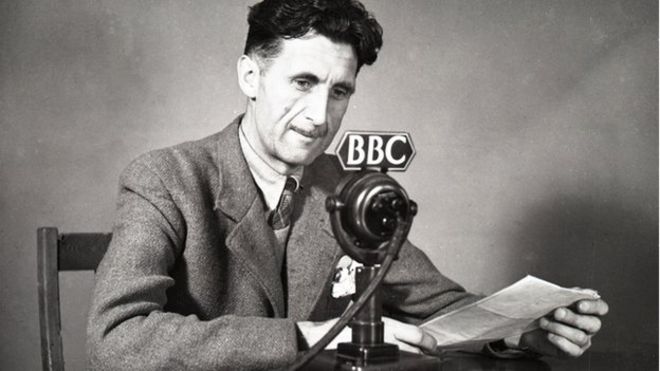
George Orwell wrote Nineteen Eighty-Four in 1949.

Now, let’s imagine you’re writing an essay about your favourite novel. A logical start would be to mention who wrote it, like so:

Nineteen Eighty-Four was written by George Orwell in 1949.

What’s the difference between these two sentences? I’m sure you’ll agree that both contain the same information. But the focus is different, isn’t it? In the first we’re focussing on the writer, and in the second, on the novel. And we change focus by changing focus – between the active voice and the passive voice.

Continue reading

Mugwumps, Bailiwicks, and Pregnant Chads: The Vocabulary of Politics

Today is Election Day for my neighbours across the Irish Sea (not to mention a day of infamy for Donald Trump as James Comey testifies), and it looks like child’s-drawing-of-a-parent’s-description-of-a-nightmare-about-Margaret-Thatcher Theresa May will win. Not too surprising though. What was surprising for some people though was when Foreign Secretary and rejected-Monty-Python-sketch-character Boris Johnson called Labour leader Jeremy Corbyn a mutton-headed mugwump early on in the election. By mugwump, Johnson meant someone who remains aloof or independent from party politics. The term has a long history, originating from a Massachusett Native-American word for war leader. The term was applied to Republican Activists in the 1884 American Presidential Election who supported the Democrat nominee Grover Cleveland. They were rejecting the political corruption of Republican candidate James G. Blaine, and were ironically nicknamed mugwumps to imply that they were sanctimonious in their removal of themselves from party politics. Mugwump is just one of the many interesting words associated with the world of politics and elections, such as:

Continue reading

Colourful Surnames

Black, White, Grey, Green, Brown, Gold/Golden. Niall, I hear you ask, why have you capitalised all those colours!? Surely you’re not going to tell us that there’s some obscure English rule that says that you have to use capital letters with colours, and we’ve all been doing it wrong all this time? God I’d love to, but no, those words are capitalised because, yes, they’re colours, but in this case I’m using them as surnames.

I’ve written before about surnames, and what they mean. Most of them have fairly mundane origins, describing people’s jobs or their birthplaces. This is because in the grand scheme of things, surnames are fairly new. Many of the earliest English surnames were attached to people to differentiate them from other people in the village with the same first name (e.g. that’s John Miller the miller, not John Taylor the tailor). If you think about a lot of common English surnames, it’s probably not too hard to imagine where they came from. But why is it that colours are so common as surnames?

Continue reading

Boot or Trunk? Hood or Bonnet?

One of the strangest areas of difference between British and American English is that of cars. In many ways, the general differences between words in both main forms of English are small and superficial. Things like removing a U from a word like colour, or swapping an R and an E around at the end of a word. Other differences are based on old uses and forms of words, and are understandably caused by 200 years or so of drift. And there’s sports.

But cars are such a relatively new invention that it always seemed strange to me that American and British English would have such different words to refer to their different parts. Specifically why a boot in British English is a trunk in American English, and a bonnet is a hood.

Continue reading

Learner Drivers at the Intersection of French and English

Would you surprised that learner is a very-commonly used English word in other languages? Well, not exactly the word learner itself, but the L-plate used on cars to indicate that the driver is a learner. I’d been driving in Belgium for a while, and had noticed that their L-plates are a blue background with a white L, as opposed to the Irish white with a red L. But I never stopped to consider that the L stood for Learner (the French translation would be apprenant or apprenti). Never, that is, until I saw a French learner driver…

Continue reading

Perfect!

Yesterday, I looked at the present perfect simple tense, a tricky customer for people learning English. The progressive aspect can also of course be in the past and the future, and can be combined with the continuous (progressive) aspect. As with the present perfect simple, the perfect aspect always joins two different time periods together. The present perfect simple is the most common way you’ll use the perfect aspect, but let’s have a quick look at the other ways we use it:

Continue reading