
Have you ever stopped to think about how strange the word honeymoon is? Why would honey and moon combine to create a compound noun meaning a holiday after getting married? Continue reading
Honeymoon

Have you ever stopped to think about how strange the word honeymoon is? Why would honey and moon combine to create a compound noun meaning a holiday after getting married? Continue reading

Since most of us probably won’t be eating it for another 11 or 12 months, I think it’s time to give the turkey its due before we forget about it again.
The word turkey (used to refer to the bird) has a surprisingly convoluted etymology. And no, it’s not a coincidence that it’s also the name of a country… Continue reading

I’ve often written about the great flexibility of English, and the wide range of options it affords those who use it. The downside to that, however, is that sometimes people’s English can get too complex and confusing. There are a few reasons for this. Sometimes, the point someone wants to make is quite complex and requires long and complex structures to be expressed. At other times, one might simply want to show off their vocabulary, or indulge in a little purple prose.
So even though English allows for a variety of registers in how one uses it, I firmly believe that one should keep one’s language as simple as possible.
Occasionally though, even the best of us can indulge ourselves, and one of the common results of this is the use of redundant words or phrases, though this can also be due to honest mistakes. Here are a few of the more common redundancies in English: Continue reading
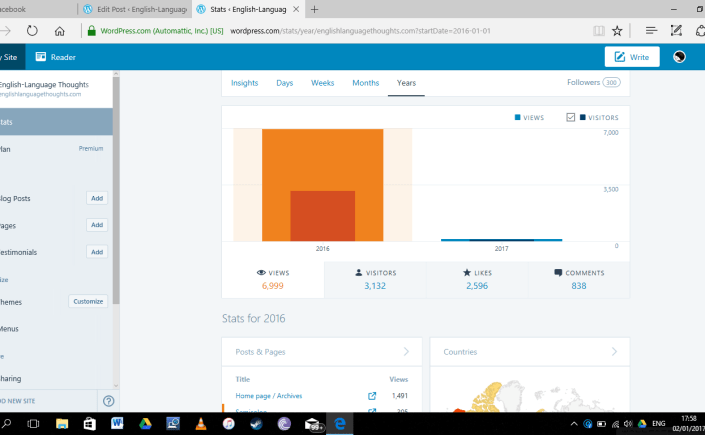
My god, what a number. Objectively, you might think it only somewhat interesting, largely, if not solely, due to those three consecutive nines. But it has a special, infuriating significance for me. Arriving home yesterday evening and going to my laptop, one of my primary thoughts was of my blog activity while I was away, a daily thought for me.
And as I was opening the laptop, a more specific thought occurred to me: having started the blog in May, I realised that the yearly section of the stats page was now slightly more interesting. Even though I’d only been blogging for six and a bit months, I was still curious to see what my final total views was. So I had as look and it was… Continue reading

So here it is, 2017. Hopefully it’s the start of a great year for you. Hopefully none of your favourite celebrities die (but statistically, some probably will). Hopefully if you’re living in Trump’s American or in Post-Brexit Britain, things aren’t too hard for you.
Typically of course, I’m most interested in how you actually say the name of this year. Is it “twenty seventeen,” or “two thousand and seventeen?” Or even “two thousand seventeen,” if you’re American. For me, there’s no hesitation: Continue reading

You might end up singing Auld Lang Syne tonight, and like a lot of people wonder, what it means, or even if it’s an English phrase. Well, it is, though strictly it’s Scots, as written by the great Scottish poet Robert “Rabbie” Burns in 1788.
The title can be translated into standard English as old long since, or long long ago, meaning that the song is about remembering long-held friendships. Which might seem like a strange song for such a forward-looking night as New Year’s Eve, but I think it’s an appropriately melancholy way to say goodbye to a year. Continue reading

It’s that time of the year when people start thinking about their New Year’s Resolutions. For the next couple of weeks you’ll probably hear the phrase to turn over a new leaf mentioned a lot. It might strike you as a strange phrase, so where does it come from? Continue reading
 English-Language Thoughts