You’re Welcome!

If you’re a generous person, you may have been saying you’re welcome a lot recently, to all those you’ve given gifts to. What do we mean when we say you’re welcome? It’s almost an afterthought: the most important information being conveyed in this part of the conversation is the thank you. Saying you’re welcome is really just wrapping a bow on the thanks, acknowledging the grateful receipt of it. When you think about the actual meaning of the words, they make the most sense if you consider someone thanking you for giving them something. What you’re saying then is that they’re welcome to whatever it is you gave to them, even if it’s something intangible like help. Even so, it still feels a bit redundant, because surely that could be taken for granted: you wouldn’t have given it to them if they weren’t welcome to it. Continue reading

A Date with Destiny

-You there, boy! What date is it today!?

-Today!? Why it’s 05/08/16!!

-Wait… so is it August or May?

Why do Americans write the date differently from the rest of the world? Not that I’m really complaining, but, well, it can be annoyingly confusing at times, especially in cases like above where the day of the month is the 12th or lower. Of course I’m just used to the European format, but I do also think it’s more logical, moving from the smallest unit to the largest. Continue reading

All of This has Happened Before, and will Happen again…

It’s déjà vu all over again – Yogi Berra

One of the downsides to trying to post something every day, is that you occasionally have a moment when, about to start a new post, you think to yourself, Haven’t I written about this already? So you try to jog your memory, and then search your blog, but can’t find anything. Sometimes you remember touching on the topic in a previous post, but as it wasn’t the focus of that post, you decide to go ahead with this one. Other times, you still aren’t sure if you wrote about this before or not, and then decide to just go ahead with it, there are probably quite a few people who didn’t read the previous post, if it exists. That was way back when you’d just started out and no-one was reading your blog.

I had that feeling, not for the first time, this morning, but at least I’m not thinking about it too much today, as I’ve obviously changed tack and decided to write about this feeling instead. It’s a little like déjà vu, I suppose, only not quite as uncanny, because there’s probably a rational explanation for this feeling. If I haven’t already written about this topic, then I’ve probably touched briefly upon it, or written something similar. Continue reading

Boxing Day

Today is Boxing Day, traditionally a day of extreme rest for those who celebrate Christmas, due to the exhaustion caused by the previous day’s eating, drinking, and resting. Unless you’re one of those simply awful people who get up at 5am to queue for the stock that clothes shops couldn’t sell during the year, now reduced in price. Then it’s probably quite a tiring day, but that’s your fault, isn’t it? For the rest of us it’s a day for watching Willy Wonka & the Chocolate Factory or Raiders of the Lost Ark, and eating Quality Street and turkey & ham sandwiches. Continue reading

Merry Christmas!

Just a quick post for today, unsurprisingly about the meaning of the word Christmas. You can probably guess that it is of course a combination of the words Christ and Mass. It’s a shortening of Christ’s Mass, which makes sense as a name for the day, and was first recorded in the 11th century. Linguistically, there’s not much else interesting about it, as its meaning is so opaque. I suppose there’s the fact that we use on before special days (on Christmas Day), and at for longer periods of celebration (at Christmas). And there’s Xmas! Even though it’s often considered a blasphemous, secular, lazy contraction of the word, it actually has a religious background. The X comes from the Greek letter chi, which in English is Christ, so it’s basically identical to Christmas.

But yeah, Mass! I remember, like many an Irish child in the 80s and 90s, thinking about when I should get mass: would I get Midnight Mass on Christmas Eve, and enjoy the pleasure of waking up on Christmas morning knowing I didn’t have to get Mass, and could spend the day playing with my new toys.

I always tried to get Midnight Mass, but sometimes I was just far too comfortable at home on Christmas Eve, and I’d leave it for the morning, which I’d always regret, although Mass on Christmas Day was always okay, because everyone was in a good mood, and you knew the Gospel story would be a good one. Midnight Mass could be great though, it always seemed to have a really special atmosphere, which even the tipsy men fresh from the pub standing at the back seemed to appreciate. Even when I started to become less religious, I’d still sometimes enjoy Midnight Mass.

I only very occasionally find myself at Mass these days. It’s interesting how I still remember lots of the responses, and find myself automatically reciting them before I realise I have. Although no-one seems to remember when to kneel anymore, so it seems everyone just sits and stands.

So whether you’re going to Mass or not, or spending Christmas in any of the other infinite ways to spend it, (or not even celebrating Christmas, but still hopefully having a nice end-of-year), I hope you have a merry one!

Noël

Why is Christmas sometimes referred to as Noël, particularly in old Christmas carols? It comes from the Latin natalis, meaning birth, as part of the phrase Dies Natalis, meaning birthday. One of the most common ways the phrase was used in Ancient Rome was to refer to Dies Natalis Solis Invicti, the birthday of the Roman sun god Sol Invictus, which, in an amazing coincidence, took place on Christmas Day. Continue reading

The Many Names of St. Nicholas

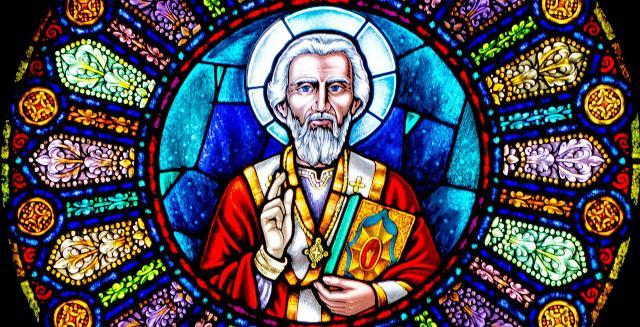
Who’s going to be coming down your chimney tomorrow night, sack of gifts in tow? Santa Claus? Santy? St. Nick? Or perhaps Father Christmas?

The most common name for the chap is of course Santa Claus, which comes from the Dutch Sinterklaas, in turn derived from St. Nicholas. A Greek bishop working in Asia Minor (modern-day Turkey), he became famous for a secret habit of gift-giving. Also, because of the many miracles associated with him, he also became known as Nikolaos the Wonderworker, and it’s a shame that name hasn’t remained popular. Continue reading