American Life: Appalachian English

It seems appropriate today to cast my eye on the United States, but not in the way you might expect. You’ve probably heard and read enough about that already, so I just want to share this video about the way the natives of the Appalachian Mountains in the eastern United States speak English. It’s delightful to hear their accents and very specific vocabulary. It sounds quite unique, though I think I definitely detect something of the original Scottish and Irish settlers. I think there’s definitely a link between the fact that they call a bag a poke, and in Irish the word for pocket is póca. I’m not surprised that their vocabulary and accent wouldn’t change much over time, being so isolated.

These are the type of people who might be stereotyped as hillbillies, but they all seem like nice folk. Hard to understand at times, but nice. I don’t think there’s much point to this really, just to show what English can be, and how diverse, culturally and linguistically, America can be.
Yeah, I Seen Her (That is to say I Saw Her…)

 I seen that guy yesterday.

I done a lot of work yesterday.

Reading those sentences in your head might drive you crazy. Such terrible grammar!, you might say to yourself. And yes, they are grammatically incorrect. They should be, of course:

I saw that guy yesterday.

I did a lot of work yesterday.

What interests me about such utterances is: how wrong are they really, and why do people get so annoyed by them? First, let’s look at how exactly they’re wrong.

The two sentences are examples of the past simple tense, referring to a discrete action in the past. To construct this tense, we need a subject (I in both these cases) and a past simple form of a verb (to see becomes saw, to do becomes did). We might also have an object of that verb, and quite possibly a time indicator like yesterday. Continue reading

Talking Business

When is good English a disadvantage?

When you’re in business.

Well, it’s not so simple obviously, but I was intrigued by an article on the BBC Capital website entitled Why Foreigners Hate English Speakers (well, the title is actually Native English Speakers are the World’s Worst Communicators, but the former was the carrot to entice me to click on it). Now I knew that the BBC were indulging in a little clickbaiting with such a provocative title, and that the actual content would be a lot milder than it promised, but still, I was curious.

And it was an interesting read. The basic gist of it is that non-native English speakers often have trouble understanding native speakers in business situations. This isn’t too surprising, as a native speaker is going to speak more quickly than a non-native speaker, and use more idioms (which may even be quite localised) which can be hard to understand. This can be particularly problematic for English speakers, as we often don’t have as much experience of learning a language to a reasonable level compared to those who’ve had to learn English, so we don’t usually realise how to adapt our speech to make ourselves fully understood. I see this cause problems all the time, but usually nothing serious. In business, however, it’s a different matter. Continue reading

How do You be Doing?

When does English sound like jazz?

When you’re Irish.

When I was a younger man I thought nothing of talking about my habits and routines in such terms:

I do be going to the park regularly.

I do be often working on Saturdays. 

If I were to translate that into more standard English, it would be:

I go to the park regularly.

I often work on Saturdays.

These latter sentences are in the present simple tense, which we use to talk about routines, habits, and general truths. So why would I choose a more convoluted form instead of something more… simple? Well, you can’t change where you’re born. Such a structure (I do be +-ing), while not so common anymore, was a common part of Irish English (or Hiberno-English). Continue reading

He Had Had Good Grammar, Had he?

What does it really mean to be grammatically correct? Is it important? People often tell you that you shouldn’t get bogged down in grammar when learning a language, and should aim for real communication. And I agree about that whole communication thing, but you still need good fundamental grammar to do so. Grammar and natural use of English don’t have to be enemies. Continue reading

Fata Morgana

I came across this word today while I was online. I’m not sure how I got to it, as my wanderings around the internet can be quite aimless, but something brought me to a list of Werner Herzog films, and seeing mention of his 1971 film reminded me of the term.

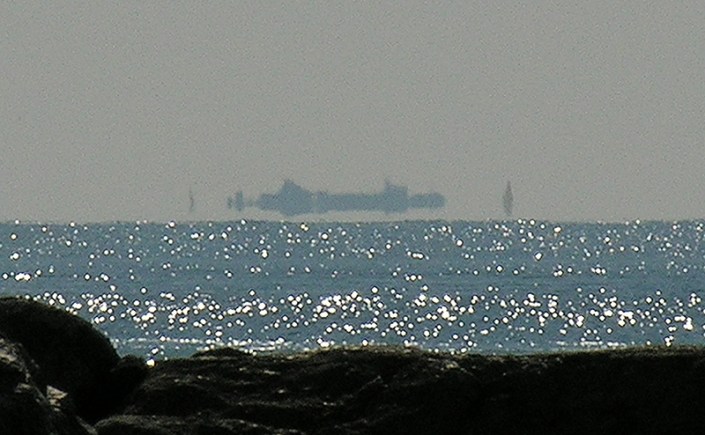
If you’re not familiar with it, it’s simply a fancy way to refer to a mirage. More specifically, it was originally used to refer to a specific type of mirage which can often be observed in the Straits of Messina between Sicily and mainland Italy. The name is the Italian translation of Morgan Le Fay, sorceress/witch/fairy half-sister of King Arthur in British legend. The effect was so named because people believed that the illusions they saw were her castle in the sky. And looking at this recent example from China, you can understand that: Continue reading

The Ten Most Common Words in the English Language

Before finding out what they are, please have a guess at what you think the ten most common words in the English language are (note that by word I mean the main word form, which includes other forms of that word. For example, only dog would appear in the list, not dogs; or have might appear but not has, had or having). So you can’t see the list by mistake, here’s a picture of some puppies. Scroll past them (if you can) for the list. Continue reading