Words I Don’t Know

Why no!, not, in fact, a blank page, but rather a continuation of the theme of what I don’t know about English (though you can expect this to be a very short series of articles). Today I want to have a look at the last book I’ve read: Cat’s Cradle, by Kurt Vonnegut. Like most books I read, it was a second-hand copy from my favourite bookshop, and one of the previous owners had underlined a lot of words. I didn’t think too much of this at first: there are often handwritten notes and underlined sections in second-hand books. That’s part of the appeal of second-hand books: the feeling that they’ve already had a full life (it must have been some journey to get from S&S Books in Sioux Falls, South Dakota, to Charlie Byrne’s Bookshop in Galway, Ireland), and the knowledge that someone else got to appreciate them. This case was slightly different though, because there were just individual words underlined, and no notes in the margins. I soon realised that these words were underlined because the previous reader hadn’t understood them. How did I come to realise this? Because I didn’t know most of them either.

Continue reading

Synecdoche, Anywhere

Synecdoche (the E is pronounced like in recipe) is a literary device in which a part of something is used to refer to the whole (or vice versa). It’s mainly considered a poetic device, and most examples that people provide are from poems. In this passage from Samuel Taylor Coleridge’s “The Rime of the Ancient Mariner,” for example, the word wave stands in for the sea:

The western wave was all a-flame.
The day was well was nigh done!
Almost upon the western wave
Rested the broad bright Sun

We use the word wave similarly when we use the phrase on the wave. Similarly, we can say a bird is on the wing when it’s flying. These are the two examples I was given when I was introduced to the term, back in, I believe, my final year of primary school. I was intrigued by this strange-sounding and -looking word, and wanted to think of other examples, though nothing really came to mind. I soon came to think of it as a purely literary device that was interesting, but not hugely relevant to my life. But now wiser and with a wider vocabulary, I can see that synecdoche is actually fairly common.

Continue reading

Hallowe’en Reads: M.R James – Collected Ghost Stories

Like humour, horror doesn’t always age well. What we find scary can change over time, largely because surprise is usually one of the main elements of horror. If something comes out of nowhere, and we don’t understand it and could never expect it, it’s scary. The first time we hear of a vampire, and read about them or see them, it’s a terrifying idea. But with repetition, it becomes known. We know what vampires do, know all the rules. So either you need to play around with people’s expectations about vampires, or you do something else.

You can this effect with lots of older ghost stories. I remember quite a few years ago buying an anthology of Victorian ghost stories, and giving up on it after a while. Some of the stories were interesting and undoubtedly well-written, but none of them was scary. Usually they involved someone staying at an old house reading about some old murder, or seeing someone they don’t recognise around the house. Then at the end they see a ghost and that’s it! Just featuring a ghost was novelty enough to shock readers, especially because most of the stories wouldn’t have been initially presented as ghost stories.

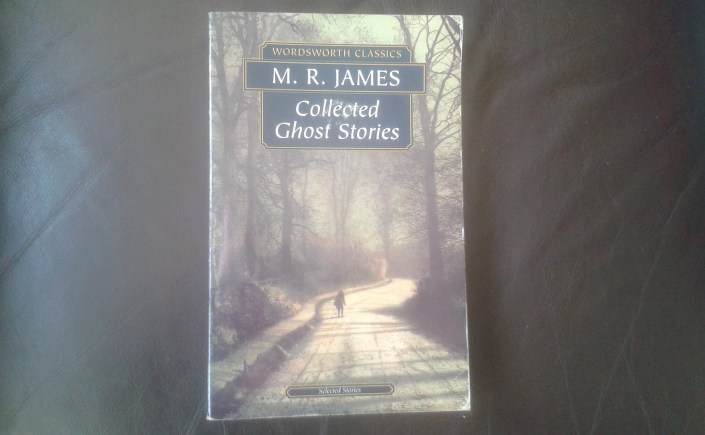
So when I picked up a cheap second-hand copy of M.R James’ Collected Ghost Stories, I wasn’t expecting too much from them. Mostly written in the first 25 years of the 20th century, I thought they would simply be far too polite and gentle to be scary. And beginning the first story, my assumption seemed to be confirmed. Most of his stories involved awkward academics puttering around quaint English villages, searching for old ecclesiastical manuscripts. And yet… Continue reading

Hallowe’en Reads: The Haunting of Hill House

                               No live organism can continue for long to exist sanely under conditions of absolute reality; even larks and katydids are supposed, by some, to dream. Hill House, not sane, stood by itself against its hills, holding darkness within; it had stood so for eighty years and might stand for eighty more. Within, walls continued upright, bricks met neatly, floors were firm, and doors were sensibly shut; silence lay steadily against the wood and stone of Hill House, and whatever walked there, walked alone.

Well if that’s not an opening paragraph that makes you want to read the rest of the novel, I don’t know what is. Published in 1959 by Shirley Jackson, The Haunting of Hill House is widely regarded as one of the finest horror novels, and, in my opinion, rightly so. Continue reading

Hallowe’en Reads: “Gramma”

Any list of recommendations for Hallowe’en reading would seem incomplete without an entry from Stephen King. I’ll forego some of the more obvious choices from among his novels though, and instead choose one of his shorter short stories: “Gramma.”

The premise is very simple: 10-year old George Bruckner lives with his 14-year old brother Buddy and their single mother Ruth. Staying with them is Ruth’s ancient, senile, bedridden grandmother. When Buddy breaks his leg playing baseball, Ruth goes to the hospital out of town to see him, leaving George alone to look after Gramma. Continue reading

What a Drag it is to See You

You might have noticed that Bob Dylan was awarded the Nobel Prize for Literature on Thursday, for “for having created new poetic expressions within the great American song tradition.” Some people have expressed surprise at this, feeling that a lyricist shouldn’t be given the award. I don’t see why not though. First of all, there’s not such a difference between poetry and song lyrics. They’re very similar structurally, tending to be divided into verses, and share the same concerns with rhythm and rhyme. I think some people feel that because song lyrics need to match the song’s music, they’re therefore less important than less important than the words of a poem or a novel which the writer was not required to match to anything. But I don’t think that’s much of an argument: all that should matter is the words, and if they’re good, and can be appreciated on their own, without music, then why shouldn’t that count as literature?

Anyway, to celebrate Bob’s win, here are some of my favourite of his lyrics in no particular order, and without commentary, because sometimes I just like them for their own sake: Continue reading

Getting your Message Across

Yesterday evening at about 6.30PM I had a moment of panic. I realised that in my rush to leave, I hadn’t read over my post and italicised all the words I should have. I couldn’t go back, and wasn’t in a situation to do it on my phone. It would just have to stay in that condition for a few hours, which aggravated me. Letting something unfinished like that out into the world seemed so sloppy.

What needed to be changed? Not much really, just two or three cases where I was referring to words, and not using them, and wanted to italicise them to make that clear. For example: “I’ve been trying to use the word application…” instead of “I’ve been trying to use the word application…”

A minor change, really, and most of my stress was due to my being a stickler for detail. Because, the post was probably quite comprehensible without my revisions (which of course I still made last night). Putting the word before application made what I wanted to say clear enough. Given also the topic of the blog and the specific context of the post itself, there was probably little ambiguity in the post. And it’s great that language can make things so clear for us, do so much of the heavy lifting of comprehensibility with words alone. But still, I’m drawn to being precise as I can in my use of language, just to be sure… Continue reading