He Had Had Good Grammar, Had he?

What does it really mean to be grammatically correct? Is it important? People often tell you that you shouldn’t get bogged down in grammar when learning a language, and should aim for real communication. And I agree about that whole communication thing, but you still need good fundamental grammar to do so. Grammar and natural use of English don’t have to be enemies. Continue reading

Talking about Language

One of the interesting things about learning to become a language teacher is just how much your vocabulary improves. There’s a lot of jargon related to different aspects of language that one doesn’t ordinarily come across in life. So here’s a fairly random sprinkling of some of the more interesting (to me!) words we language teachers learn to use: Continue reading

Might is Right?

Teacher: Yes, that’s correct: We say “In the future, the planet will be warmer.” So when we’re talking about the future, we use will to…

Student: But teacher you can’t!

Teacher: Excuse me?

Student: You can’t say will because you’re not sure! What if things change? You have to use might, because maybe it won’t be warmer in the future! You can’t be certain!!

Teacher: Ok, tell me: what day will it be tomorrow?

Student: Saturday.

Teacher: Ah, but how can you be sure it’ll be Saturday? What if the world ends this evening? Continue reading

1,000s are Using this App to Learn 10 Languages! Find out How!!

You may have come across lots of ads like this online recently. I know have, though I think that might be targeted advertising based on my interests in language. Obviously, most of the ads like this are just clickbait, but there are some language-learning apps such as Duolingo and Babbel which are quite popular and seem to be well-regarded.

I admit to being a bit sceptical about such apps, probably because if they’re really as effective as they claim to be, I’ll be out of a job! But also, having seen how much work goes into both teaching and learning a language, I find it hard to imagine a simple app could be up to the job. Here are some of the aspects of learning a language that I assume an app would struggle to provide: Continue reading

A Slice of Life

You might have noticed that I haven’t been so active in the last few days. Well, not to worry (I assume you’ve been worrying): I’ve just been a little busy. As I work in an English-language school, this is always the busiest time of the year. People always get surprised at that. They assume that because we’re a school, we have the same schedule as state schools, and have generous summer holidays, and mid-term breaks to relieve some of the monotony that sets in after a few months of work. Yet alas, that’s not the case (we only close for 2 weeks at Christmas), and as most normal people are enjoying their holidays, my colleagues and I are working harder than at any time of the year.

And there’s a lot of work involved in a language school. Taking bookings, processing payments, arranging transportation and accommodation, hiring and training teachers, planning and booking activities, testing and placing students, dealing with their issues about classes, books, their level, accommodation, personal problems…well, there’s a lot to it. And in July and August we’re doing it for much larger numbers of students, which in the summer includes individual adults and teenagers, big groups of teenagers, and families. I’m not complaining though: I thrive on the pressure and think that it pushes me to work at my best. Continue reading

Eat, Drink, Have

Imagine the situation:

An English-School classroom, with a Beginner or Elementary class. The teacher has put a picture of someone with a glass of water to their lips.

—What is she doing?

—She is… drinking the water.

—Yes, very good! Now, next…

The teacher now displays an image of someone sitting down to a meal.

—Ok, now can somebody tell me what this person is doing?

—Eating.

—Yes, very good! So, we eat…

—food.

—Yes, and we drink…

—uh, drinks.

—Yes, excellent!

That might seem pretty logical. To eat and To drink are two very common, basic verbs, and students need to understand exactly what they mean and how to use them, don’t they? Well, yes, but how do we really use these two verbs? How often do we really use them? Continue reading

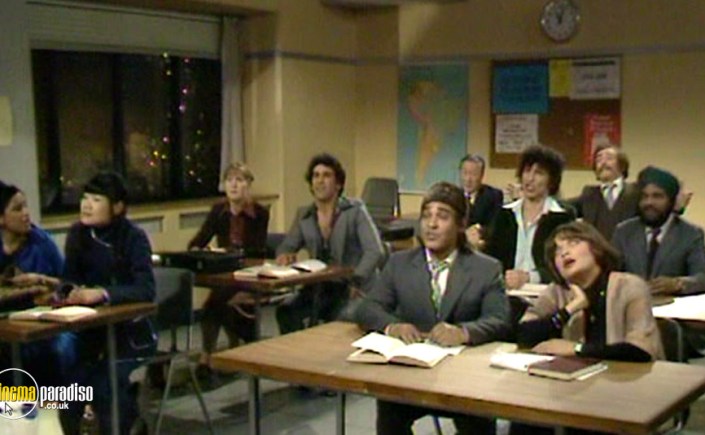
Teaching on TV

9am:

Teacher: Good morning class!

Class: Good morning!

*teacher writes Hello, my name is Niall. on the board*

*teacher points to self, says Hello, my name is Niall*

Teacher: Now Saud, you!

Pedro: Hello, my name is Saud.

Teacher: Very good! Now Anna, you.

Anna: Hello, my name is Anna.

Teacher:Yes Anna, very good! Now Chen, you.

Chen: Hello, my name is Anna.

*everyone laughs*

Teacher: Ha ha, no Chen, your name is Chen!

Chen: Ah sorry! Hello, my name is Chen!

Teacher: Excellent!

9.02am:

*bell rings*

Teacher: Ok everyone, before you go, I want you to write Hello , my name is… 50 times on a suitably blank surface. Class dismissed!

I think the above is pretty representative of most of the depictions of English-language classes I’ve seen in films and TV programmes. I know everyone gets annoyed when their profession is depicted on screen and it’s quite inaccurate. We can’t expect film and TV writers to be experts in a job that might appear briefly in only one scene. But what annoys me about the way English classes are shown is that it’s indicative of a lot of people’s misconceptions of English-language classes.

Let’s look at what’s wrong with the lesson above.

Continue reading