He’s Much Smarter than I

Not a sentence I have occasion to use very often, obviously. It’s a fairly straightforward one, an example of a comparative form. I’m comparing myself with another person. Simple. Not the sort of thing we ever have to really think about it. Like much of the basics of grammar in your native tongue, it’s something you know and use correctly automatically. Well, you know it now, because you had to pick up how to use comparative forms correctly during your childhood.

Continue reading

A Tale of Three Translations

I was watching the news yesterday, and there was a story about the stone in the image above, which features the lyrics of the song “Galway Bay” in English, Latin, Irish, and French. It was erected, appropriately enough, in my hometown of Galway last year, overlooking Galway Bay, as part of a poetry trail featuring similar plaques with translations of works by different Irish writers. Funnily, I wasn’t really aware of the content of the plaque until yesterday, even though for most of last year I lived very close to it, and in fact passed it practically every day. I had seen it alright, but in my defence, I was usually cycling, driving, or running, so never really stopped to look at it, and there are many little cultural markers like that around the city, so you do kind of get used to them.

first.jpg

The offending plaque, as it is now, in storage

Anyway, the issue with the plaque was with the Irish-language translation. A few months after it was erected, An Coimisinéir Teanga (the Language Commissioner) received a complaint about the quality of the Irish translation, which suggested that it didn’t capture the spirit of the original English-language lyrics. In a report, An Coimisinéir stated that there were approximately 40 errors in the 20 lines of the Irish version. I found this quite shocking, so had a look at the lyrics myself.

Continue reading

Happy Fourth of July!

Happy Fourth of July to all of my American readers (about 50% of all my lovely readers)! I hope you’re enjoying celebrating your independence, and I certainly hope that you appreciate that I’m publishing a second article today just for you. You see, I’ve got into a habit of writing articles in the evening (it’s currently 8PM GMT summertime), but scheduling them to be published the following morning, so I don’t have the pressure of having to finish it quickly that evening. That’s why I published an article about Wimbledon on the second day of the tournament. But I thought I couldn’t possibly publish an article about the Fourth of July on the fifth, so here we are.

I originally thought about writing about some uniquely American words, or American English more generally, but I’ve already written about that, and there’s not much to be said there that you don’t already know about. But then at some point this afternoon, I was struck by a thought: why do Americans call it the Fourth of July, when normally they use the other format to refer to dates? Why not July Fourth?

Continue reading

I’ll Leave it in Your Inbox

I was thinking today about the books I’ve bought but have yet to read, and about how to describe those books. My instinct was to refer to them as my to-do list, but then I decided that that didn’t really work, because they’re not a list. This is the point where most people would stop thinking about it, because it wasn’t even part of a conversation anyway. Nevertheless, I persisted, and thought about the word inbox as a possibility. Yes, that made sense. I get them, put them in the imaginary inbox until I take one, read it, and then transfer it to my imaginary outbox. Good, so the pile of books beside my bed (and the others in the other room: there are a lot of them) is my inbox. Not that I stopped thinking there though.

Continue reading

Words I Don’t Know

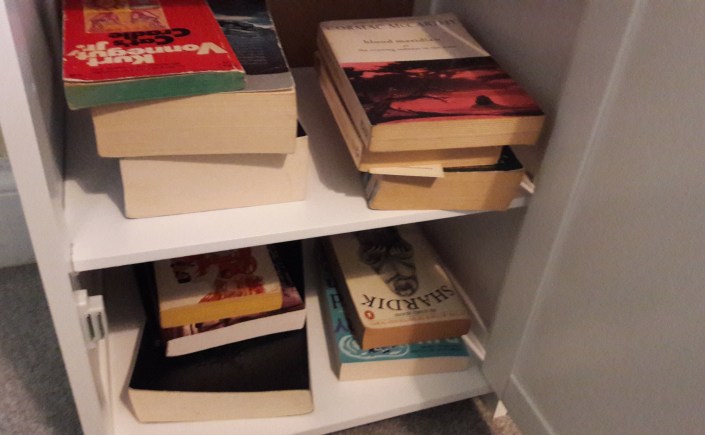
Why no!, not, in fact, a blank page, but rather a continuation of the theme of what I don’t know about English (though you can expect this to be a very short series of articles). Today I want to have a look at the last book I’ve read: Cat’s Cradle, by Kurt Vonnegut. Like most books I read, it was a second-hand copy from my favourite bookshop, and one of the previous owners had underlined a lot of words. I didn’t think too much of this at first: there are often handwritten notes and underlined sections in second-hand books. That’s part of the appeal of second-hand books: the feeling that they’ve already had a full life (it must have been some journey to get from S&S Books in Sioux Falls, South Dakota, to Charlie Byrne’s Bookshop in Galway, Ireland), and the knowledge that someone else got to appreciate them. This case was slightly different though, because there were just individual words underlined, and no notes in the margins. I soon realised that these words were underlined because the previous reader hadn’t understood them. How did I come to realise this? Because I didn’t know most of them either.

Continue reading

“Besides” and “Anyway:” a Teacher’s Nightmare

This post is inspired by the moment I noticed that I finished a recent post with a sentence beginning with besides, and ending with anyway. Not so unusual, but it brought back some painful memories…

Quite a few years ago, I was teaching an IELTS class (IELTS is a tough Academic-English exam). The lesson was a vocabulary one, about using linking words in writing. Quite straightforward for me at that stage, as I’d been teaching for some time. I had a quick look at the main exercises (I’d like to say I wasn’t provided with much time to prepare the lesson, but I’m pretty sure my quick look at the materials was solely due to my overconfidence), and was satisfied: Ok, there’s furthermore, however, although, despite, in addition to… yeah, that’s easy, I’ve time to relax for a bit.

Into the lesson then, and everything was going ok. Ok, until I had a look at the exercise I’d just had the students start. It was pretty straightforward, the students had a text with gaps, and had to choose which words to put into the gaps. Normally, I’d get the answers from them afterwards, and get them to explain what they meant. Which would normally be fine, until I spotted that one of the words to be used was besides, and it was supposed to fit in the last gap. And I asked myself: What the hell does besides actually mean!?

Continue reading

Pride: the Language of LGBT

It’s Pride Week this week, and this weekend sees a lot of Gay Pride events around the world. Here in Ireland there’s a Gay Pride Parade in Dublin today as a culmination of a week’s celebrations. It’s great that such an event is now a normal part of life here that people from all walks of life can get involved in and enjoy. It wasn’t too long ago that such a thing was inconceivable: homosexuality was only decriminalised here in 1993 after all. In line with the great strides many nations have made in dealing with sexual and gender identity in general, have been the developments in our language, as we learn to refer to ideas which were previously hidden, or which we’d never conceived of before. I’d like to take a look at a list of some of these terms and phrases:

Continue reading