
Q is unique among the letters of the English alphabet in that it always has to be partnered with another letter (not counting loanwords like Quran, Qatar, and Iraq).
Why does it always have to be followed by a U? Continue reading

Q is unique among the letters of the English alphabet in that it always has to be partnered with another letter (not counting loanwords like Quran, Qatar, and Iraq).
Why does it always have to be followed by a U? Continue reading

The verb sentire in Italian is an interesting one. I’ve come across it a few times recently on Duolingo, meaning to hear. I could see how it was related to English words associated with feelings like (to) sense, sensitive, sentiment(al) etc., but found it curious that in Italian it seemed to be used only to refer to one sense. Seemed to anyway… Continue reading

You never what you’re going to find on the internet, do you? I sometimes have a look at the comments on this blog that are marked as spam. Partly because the occasional genuine comment gets thrown in there, but mainly out of curiosity.
Curiosity as to why those responsible might think I’d fall for their obvious tricks, and curiosity about how successful they are. Mostly though, curiosity about the interesting forms of English contained therein. Take this recent comment, for example: Continue reading

On Saturday afternoon, I decided I felt more like writing (this) while having a coffee in town (apparently the average noise level in a coffee shop is quite inducive to writing), rather than at home, so after wandering around a bit (I had to finish the album I was listening to, of course), I settled on a branch of Caffè Nero.
While queuing, I began thinking about the fact that I’m going to visit Rome next month. I’d always assumed the chain was named after the Roman emperor Nero, and considered that even though they seemed to use a lot of Ancient-Roman style design in their décor, the coffee shop probably doesn’t offer an authentic Ancient-Roman experience. And then I got to thinking about the famous myth that Nero sang and played the fiddle while the Great Fire of Rome raged around him (he probably didn’t: it’s more than likely propoganda spread by the Flavian dynasty that succeeded him).
And then I thought: why do we sometimes call a violin a fiddle? Continue reading
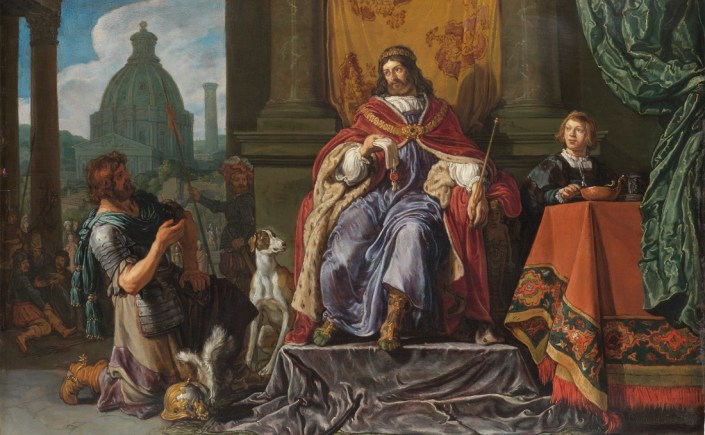
While writing about the word citizen, via denizen recently, I naturally thought of the word citizen in contrast to subject. Naturally, when describing people, they’re quite different. Continue reading

Glamour! Sophistication! Punctuation! Isn’t this what you think of when you hear the phrase Ladies’ Day?
Ladies’ Day is a common aspect of horse-racing festivals, and today is Ladies’ Day at the Galway Horse-Racing Festival. As seems to be the tradition, it’s a warm day of greasy rain and even greasier teenage boys in oversized suits drinking during the day.
I’m not a fan, suffice it to say, but each to their own. Anyway, one of the most interesting things about Ladies’ Day is Ladies’ Day: that is, the phrase itself, and how almost everyone has to stop and think for a second about how to spell it.
That’s all down to the apostrophe of course. Is it Ladys, or Lady’s, or Ladies, or Ladies’? Well obviously it’s Ladies’, because that’s what I’ve been using from the start, but why is it Ladies’? Continue reading

About a day before the time of writing, President Donald Trump, of the United States of America, said the following, in relation to meddling in the 2016 election:
 English-Language Thoughts