Son of a Bitch

Yeah, I mean, I don’t want to get too political. Every Tom, Dick, and Harry’s got their hot take on Donald Trump, so I want to keep things focussed on language: grammar, etymology, stuff like that. Hang on, let me just have a quick look at Twitter before I write… He’s said what!?…

On Friday, Donald Trump, somehow President of the United States, weighed in on the controversial issue of professional American-football players protesting against racial injustice and police inequality towards African Americans. He naturally employed all the gravitas and diplomacy one would expect of his office, and said the following:
Continue reading

Calling a Nazi a Nazi

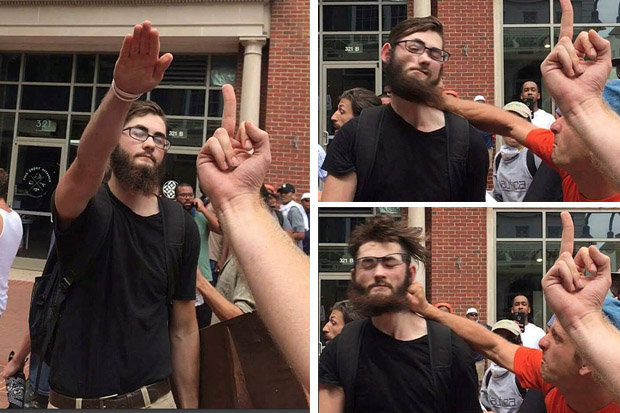
Following the violence (from armed Nazis, and the one side they represent) in Charlottesville, some people have suggested that the perpetrators only acted like brutal, thuggish Nazis, because people had been calling them brutal, thuggish Nazis for so long. Of course they’re going to act like Nazis if you keep calling them Nazis! Obviously it’s an attempt to take the blame away from the actual Nazis committing the violence. It’s an attempt to say, Look, these are just troubled young men not happy with the way they’re country’s going. But they’ve been demonized by SJWs, and that’s made them lash out in frustration! What do you expect when you call someone a Nazi!

There a couple of assumptions being made here. The first is that if you label someone with a negative name often enough, they’ll become what you call them. And that seems logical enough. Imagine how angry it would make you to unfairly labelled as something as terrible as a Nazi!? Except, that only really works when the label is applied unfairly, doesn’t it? So let’s take a moment to have a look at some of the people being called Nazis:

Continue reading

Mugwumps, Bailiwicks, and Pregnant Chads: The Vocabulary of Politics

Today is Election Day for my neighbours across the Irish Sea (not to mention a day of infamy for Donald Trump as James Comey testifies), and it looks like child’s-drawing-of-a-parent’s-description-of-a-nightmare-about-Margaret-Thatcher Theresa May will win. Not too surprising though. What was surprising for some people though was when Foreign Secretary and rejected-Monty-Python-sketch-character Boris Johnson called Labour leader Jeremy Corbyn a mutton-headed mugwump early on in the election. By mugwump, Johnson meant someone who remains aloof or independent from party politics. The term has a long history, originating from a Massachusett Native-American word for war leader. The term was applied to Republican Activists in the 1884 American Presidential Election who supported the Democrat nominee Grover Cleveland. They were rejecting the political corruption of Republican candidate James G. Blaine, and were ironically nicknamed mugwumps to imply that they were sanctimonious in their removal of themselves from party politics. Mugwump is just one of the many interesting words associated with the world of politics and elections, such as:

Continue reading

Covfefe

By now you might be aware of Donald Trump’s latest addition to the English language: covfefe. If you haven’t heard yet, at 12:06am Washington time last night, the President of the United States tweeted:

Despite the negative press covfefe

…and that was it! Obviously he was deliberately tantalising us with this new word he’d coined, throwing it out into the world and waiting for us to figure out its meaning based on subtle clues he’s left, while he slept soundly. Here are some of my ideas:

Continue reading

Trump’s Triumph?

So Donald Trump is being hailed in some quarters as “presidential” for his address to Congress last night. And fair enough. Though there didn’t seem to be much substance to it, his tone was noticeably more measured than any of his public appearances to date. Not that that was particularly hard mind you. When you think about it though, describing his as presidential seems like something of a back-handed compliment, and at best damning him with faint praise. The word presidential means like or related to a president, so isn’t that the least that would be expected of him? Surely he should be presidential by default? But I understand people being pleasantly surprised. Regardless of whether you agree with his policies or not, it’s hard to deny that he’s had a very direct, blunt style, in contrast to his predecessors. Continue reading

Politics and the English Language

If the ban were announced with a one week (sic) notice, the “bad” would rush into our country during that week. A lot of bad “dudes” out there! – Donald Trump, 30/01/17

First of all, it’s not a travel ban – Sean Spicer, 31/01/17

Political language — and with variations this is true of all political parties, from Conservatives to Anarchists — is designed to make lies sound truthful and murder respectable, and to give an appearance of solidity to pure wind – George Orwell, 1946

When is a ban not a ban? Continue reading

Shut the Gate

No-one would ever accuse the average tabloid writer of a great love for the breadth of the English language. They go for a particular sensationalist and informal tone, with a specific vocabulary, and stick with it. Unlike broadsheet journalists, who tend to play it down the middle or go highbrow, they have a particular house style. This is even more true for tabloid sub-editors, who write the headlines, except for the odd occasion when they go above and beyond the call of duty.

I’m thinking of a specific journalistic trend, which, in fairness, isn’t restricted to tabloid journalism. And that trend is the tendency to add the suffix -gate to a word to refer to any manner of scandal. Some notable recent examples include Continue reading