Sautéd

Do you ever see pretentious French terms on menus and wish you knew what they meant without having to look up their meaning? Perhaps you choose a dish in a restaurant which includes sautéd greens, but you have no idea what they exactly are. Well, let me help you with this one at least. And talk about Ancient Greek philosophers and heraldry too, naturally.

Continue reading

The Fates and The Weird Sisters

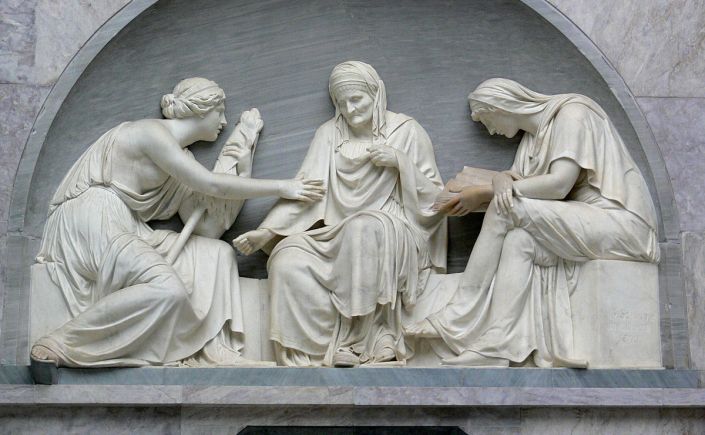
A little more Greek mythology for you.

The other day, I wrote about the Furies, and as usual I initially confused them a little with the Fates

Continue reading

Colon

While writing about military ranks last week, I wondered if the word colony, which I’d touched on briefly the week before, was related to the word column, from whose Italian translation the word colonel comes from.

My mind then thought of other words, like colony and colon: maybe they could be related too. Colony, maybe that comes from the Latin for column, columna, because it originally referred to a garrison town, where a column of soldiers were stationed. That sounds plausible, doesn’t it?

Continue reading

Why do we Call a Psychiatrist a Shrink?

Good question!

Continue reading

How did the Oceans Get their Names?

Quite simply, in the case of the Pacific at least.

Continue reading

The Etymology of Instagram

While writing about social media yesterday, a thought occurred: what’s the etymology of the name Instagram? The Insta- part seemed pretty obvious, but I was curious about the –gram part. Luckily, when you want to find out about the etymology of the names of social media, you don’t have to do too much digging…

Continue reading

Holding out for a Hero

When writing about James Joyce last month, I got to thinking about the word hero. Two things made me think about it: the fact that an early draft of A Portrait of the Artist as a Young Man was known as Stephen Hero, and how often I referred to Leopold Bloom as the hero of the novel Ulysses.

On the surface, it seems like a fairly straightforward word. You can think of its meaning pretty easily, I’m sure: someone brave, with exceptional abilities. Someone we can look up to. And this has always been the meaning of the word. It comes from the Greek ἥρως (hērōs), meaning protector or defender, and was often specifically used in Ancient Greek myths to refer to heroes of divine ancestry such as Heracles. So, not so different from how we use it today. Except, as I alluded to in the first paragraph, when we use it as a literary term.

Continue reading