Teacher, can I say…?

This is the beginning of one of the most common questions English teachers get asked. And the answer is usually, Well, it’s technically correct, but we never actually say that in English. Which in turn is usually met by frustrated sighs. For all the language’s flexibility, we often fix on only one of the many possible ways to express an idea. This is often a tremendous source of frustration for learners, especially if they’re feeling pleased about using a certain grammar form, only for their teacher to tell them what they’re saying doesn’t really sound natural.

Often, this stems from direct translation from one’s mother tongue. In French for example, it’s standard to use nouns to refer to feelings. For example: Continue reading
Way Cool!

There are two quite contrasting, yet equally fascinating aspects of the English language. One, is the sheer variety of words and phrases one can use to refer to the same thing, each adding a slight difference in meaning or tone. And the other is the sheer utility of some words, which can be used with a variety of meanings. Some of these words are so common that we don’t even think of how many ways in which we use them.

Take the word way, for example. Continue reading

Burns Night!

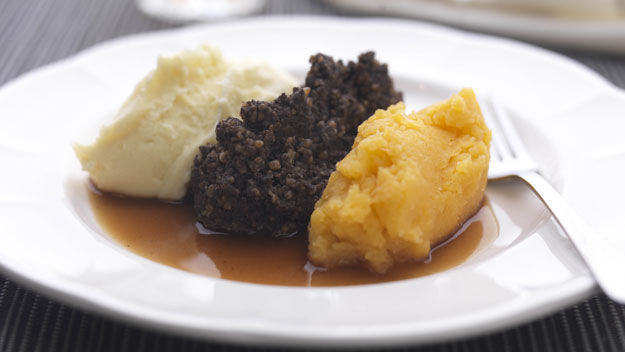
I’ve just realised it’s Burns Night!

If you’re unfamiliar with it, it’s a Scottish celebration of the poet Rabbie Burns, whose best-known is probably the song Auld Lang Syne. The night involves the Burns Supper, which can be quite an elaborate affair, and invariably involves a meal of haggis, neeps (turnips), and tatties (potatoes). Before it’s served there’s the Piping of the Haggis. Bagpipers play as the delicious dish is brought in, and the host or a guest then recites Burn’s Address to a Haggis:  Continue reading

How Very Odd…

Odd is, in many ways, an odd word. It’s the opposite of even, referring to a number not divisible by two. But it can also mean strange. As well as those two common meanings, in some dialects of English it can mean occasional or infrequent. Consider the Australian Vietnam-War movie The Odd Angry Shot. In Ireland, we might say something like I only go to the cinema the odd time now, because it’s so expensive. These disparate meanings are all interconnected though. Continue reading

WTF!?

The F word.

F***

F**k

F*ck

To give you fair warning, if you’re of a sensitive nature regarding swearing, that I’m going to type the full word in a few lines. And a few more times after that. You may want to give this one a miss. Continue reading

Shut the Gate

No-one would ever accuse the average tabloid writer of a great love for the breadth of the English language. They go for a particular sensationalist and informal tone, with a specific vocabulary, and stick with it. Unlike broadsheet journalists, who tend to play it down the middle or go highbrow, they have a particular house style. This is even more true for tabloid sub-editors, who write the headlines, except for the odd occasion when they go above and beyond the call of duty.

I’m thinking of a specific journalistic trend, which, in fairness, isn’t restricted to tabloid journalism. And that trend is the tendency to add the suffix -gate to a word to refer to any manner of scandal. Some notable recent examples include Continue reading

The Best Words

I don’t like to get too overtly political in this blog. While I think everyone should be conscious of what’s going on around them, ultimately this blog is language-focussed, and I prefer to keep it that way. And while it’s hard not to avoid politics at the moment, I want to take a brief look at Donald John Trump, President of the United States of America, but specifically the words he uses. Continue reading