They’re all racist, aren’t they?

But the Irish are racist, aren’t they? (internet commenter, 2016)

I don’t mean to be racist, but the Poles are the racist f**kers on the planet. (idiot who won’t be named, 2000)

Recently, I came across the first sentence above, somewhere deep in the comments section of an article I’ve long since forgotten about. I was surprised, as I didn’t consider myself to be racist, nor did the majority of my compatriots seem to be. Reading on, things were cleared up a little.

I came to realise that the person was referring to a belief that Irish-Americans are racist. Which let me off the hook, but then I remembered that the article was about an Irish actor, as in, from Ireland, so the person was not only indulging in wild generalisations, but also conflating being Irish-American with being Irish. There was a whole heap of confusion going on. Continue reading
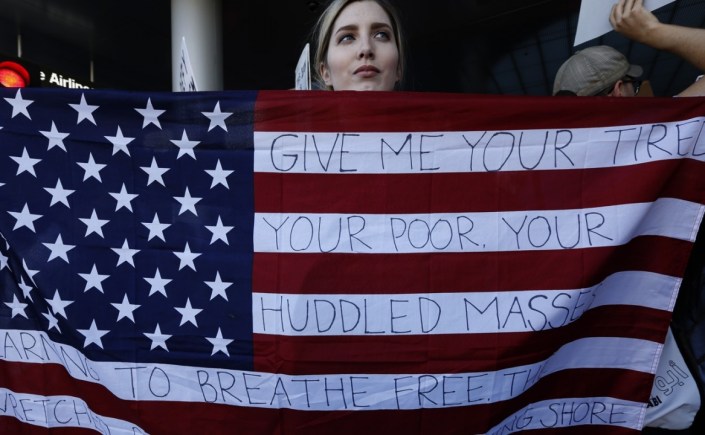
Ban

I suppose I should answer the question I started with yesterday: When is a ban not a ban?

The answer of course, is: when it’s not a ban. Continue reading

Politics and the English Language

If the ban were announced with a one week (sic) notice, the “bad” would rush into our country during that week. A lot of bad “dudes” out there! – Donald Trump, 30/01/17

First of all, it’s not a travel ban – Sean Spicer, 31/01/17

Political language — and with variations this is true of all political parties, from Conservatives to Anarchists — is designed to make lies sound truthful and murder respectable, and to give an appearance of solidity to pure wind – George Orwell, 1946

When is a ban not a ban? Continue reading

Commonly-Misspelled Words

Spelling is hard. We’re usually gradually eased into it. We pick up words first by hearing them, and then at home (hopefully) and at school we’re exposed to written words, usually pretty simple ones that look as you might imagine from hearing them. Dog, cat, hat etc. Then the more we read, the more we get used to words with less phonetic spellings. That’s how you spell laugh? And though? Ok, if that’s the way it is. Sometimes, we’ll come across words we’ve heard, but whose spelling we don’t recognise. Usually at some point we’ll figure out through context that this strange-looking word is actually a common one we’re familiar with, but that can take a long time in some cases.

But despite all that, there are some words, which either through their length and complexity, or sheer counter-intuitiveness, prove quite difficult to spell. Here are some of the most-commonly misspelled words: Continue reading

Ill-Starred

The stars have always been important to us. When our first ancestors first noticed that those strange lights in the sky moved gradually over time, they tried to find explanations for this phenomenon. Perhaps these movements were linked to seasonal changes, and unpredictable, calamitous events. Perhaps they were gods, or great creatures like bears and crabs, manipulating events here on Earth. Continue reading

“Boy, those Germans have a word for everything!”

I’ve often written about how modern English owes so much to old Germanic languages. These connections aren’t always evident though. Words evolve over time and drift away from their origins. Plus, a lot of what English gained from these languages and proto-languages is not easy to see on the surface. Syntax, grammar, and compound-noun formation are not as easy to recognise as individual words. Which is why Latin-based languages can seem superficially more similar to English, with many words sharing similar etymologies to English ones (though the English ones tend to be more formal).

The result of this is that there don’t appear to be too many words shared between modern German and English. There are a few however, and in honour of English’s origins in Germanic languages, I’m going to look at the German words that we use in English: Continue reading

Craft

via Daily Prompt: Craft

Craft is a word that has long been a noun and a verb. One worked on one’s craft, and a craftsman crafts various objects. In recent years though, it has become commonly used as an adjective, particularly to refer to craft beer. Whatever your feelings about craft beer (either pretentious, over-priced, bitter stuff, or refreshing, lovingly-crafted independent alternative to the big breweries’ fare), it’s hard to deny that it’s become quite popular. And now it’s quite common to find many other craft food and drinks.

Why have craft food and drinks taken off so? Continue reading