Bloomsday

Today is Bloomsday, which is perhaps not the best-known day of celebration. It’s a celebration of all things James Joyce, and more specifically, his great novel Ulysses (1922). Bloomsday always falls on 16 June, because that’s the day on which the book is set (in 1904). And it’s named Bloomsday in honour of the novel’s hero, Leopold Bloom. And of course his wife Molly Bloom too, who has a very important part to play in the book. Why though, would we have a day of celebration for a single book?

Continue reading

Hung or Hanged?

This is a common question for English speakers: which is correct.? As usual, the real answer is complex, and possibly even interesting. But first, the simple answer: we use hung to refer to hanging an inaminate object, and hanged to refer to hanging a person. And if you find that hard to remember, don’t worry!: there are plenty of people out there who will be more than happy to correct you if you get it wrong! But I wonder: would they be able to explain to you why you’re wrong?

Continue reading

Who’da Thunk it!?

The English language has a complicated relationship with rules. Almost every major grammar rule you can think has at least a few exceptions. But then there are a few unwritten rules that English speakers adhere strictly to, even when we’re not aware of it. Still, English isn’t generally a stickler for the rules, which makes sense considering it’s quite a mongrel language. This is why I prefer to think of English as having patterns and trends, as opposed to rules. Today, I want to look at one of those trends. To do so, I’ll begin by asking you to consider what the following words have in common:

Continue reading

“I’m Sorry Dave. I’m Afraid I Can’t Do That.”

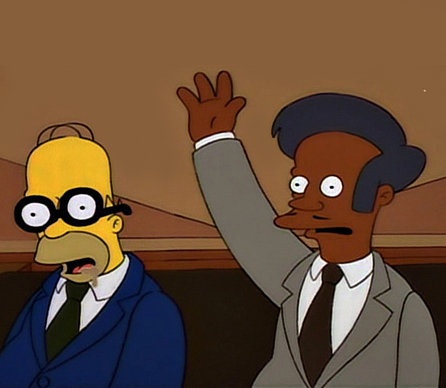
On Sunday, I naturally found myself thinking about how scary a mummy actually is, as a horror character. I think I’m with Homer Simpson on this one:

Ooh, pretty creepy. Still, I’d rather have him chasing me than the Wolfman.

Even more naturally enough, for me anyway, this in turn got me thinking about how we talk about being afraid in English. It’s quite easy to translate adjectives like afraid, scared and frightened into other languages because fear is such a primal feeling that we tend to think of it in the same way across languages. Terror and horror might be more complex, but the basic sense of fear is one we all recognise. A sentence like…

I’m afraid of spiders.

… isn’t hard to translate, or for a learner of English to understand. But what about this famous line from 2001: A Space Odyssey:

I’m sorry, Dave. I’m afraid I can’t do that. 

Imagine you’re an English teacher and you have to explain a) what I’m afraid means in this case, and b), why we specifically use I’m afraid instead of other phrases. The first task’s not too bad: you could just say it means I’m sorry, and that’d be good enough. But what about explaining why we use it?

Continue reading

Hacked!

The verb to hack, in a computer-related sense, has been around since the 80s, though it seems to be more prevalent recently, thanks mainly to the hacking scandals surrounding last year’s American Presidential Election, as well as the many less important scandals which pop up on the news fairly regularly. It’s not surprising really that nowadays, hacking is synonymous specifically with computer hacking, given how integrated computers are into every aspect of life.

Of course you’re probably aware that that’s not the original meaning of the word.

Continue reading

The Mummy, Mammy, and Mommy

Q: What did the Ancient Egyptian postman say to the boy?
A: “Hey, fellow, is your mummy home?”

Christmas-cracker-joke writers and unfunny uncles have long delighted in the double meanings of the word mummy. I thought about this coincidence a little recently with the release of the bland new Tom Cruise mummy film.

Unsurprisingly, there’s no link between mummy in the Ancient-Egyptian sense, and to refer to a mother. Mummy in the shambling-around-in-bandages sense is derived from the Persian word mūm  which referred to both an embalmed corpse and the embalming substance involved in the process of mummification. The other sense of the word mummy though, I find much more interesting.

Continue reading

“I’d Been Being Watched!”

Back when I was writing about ablaut reduplication, I read this article on the BBC website, which mentions this unwritten rule, and other structures that we use unconsciously. It’s interesting and worth reading, but I was struck by one passage in particular:

There are so many tenses you can use without even thinking about it, and almost certainly without being able to name them. It depends how you count them, but there are about 20 that you deploy faultlessly. The pluperfect progressive passive for an extended state of action that happened to you prior to another action in the past is, when you put it like that, rather daunting. But then you’d happily say “I realised I’d been being watched” without breaking sweat or blinking.

Eh, not quite without breaking a sweat, I think! Certainly the sentence is grammatically correct, and an example of the passive voice. The active version would be I realised someone had been watching me. We then change that to passive by changing the verb to the past-participle form (watched) and using the appropriate form of to be (had been being – past perfect continuous). But is it really that easy for even a native speaker to say this, and how often would we really use this form?

Continue reading