Noël

Why is Christmas sometimes referred to as Noël, particularly in old Christmas carols? It comes from the Latin natalis, meaning birth, as part of the phrase Dies Natalis, meaning birthday. One of the most common ways the phrase was used in Ancient Rome was to refer to Dies Natalis Solis Invicti, the birthday of the Roman sun god Sol Invictus, which, in an amazing coincidence, took place on Christmas Day. Continue reading

The Many Names of St. Nicholas

Who’s going to be coming down your chimney tomorrow night, sack of gifts in tow? Santa Claus? Santy? St. Nick? Or perhaps Father Christmas?

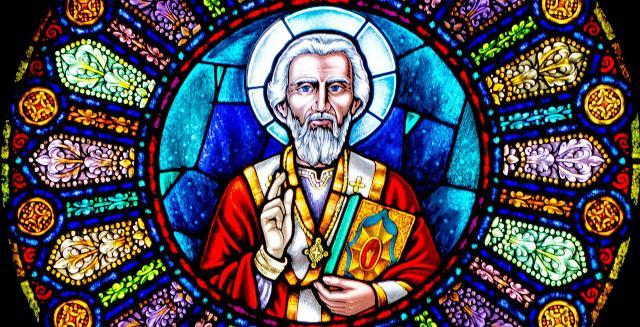
The most common name for the chap is of course Santa Claus, which comes from the Dutch Sinterklaas, in turn derived from St. Nicholas. A Greek bishop working in Asia Minor (modern-day Turkey), he became famous for a secret habit of gift-giving. Also, because of the many miracles associated with him, he also became known as Nikolaos the Wonderworker, and it’s a shame that name hasn’t remained popular. Continue reading

Merry Holidays, Happy Christmas!

Do you prefer to say Merry Christmas, or Happy Holidays? It seems that every year people get all het up about other people saying Happy Holidays, and spread stories of doubtful veracity about people not being allowed to say Merry Christmas to avoid offending non-Christians, all part of the grand “War on Christmas.” Which seems to be largely in people’s heads, as most examples of it tend to be exaggerated or simply not true. At worst, most cases cited as part of the “War on Christmas” seem to simply involve acknowledging Christmas alongside other ways to celebrate this time of year, like the infamous Winterval festival in Birmingham (England) in 1997. It became known as a byword for the “War on Christmas,” even though it actually involved celebrating Christmas, Diwali, and secular events like New Year’s Eve (the front cover of the brochure featured the word Christmas six times and a picture of a Christmas Tree, and the word Christmas featured on every page). Continue reading

Winter Solstice

Today is the Winter Solstice, or Midwinter, here in the Northern Hemisphere; the shortest day (or, if you prefer, the longest night) of the year.

The word solstice comes from the Latin solstitium, meaning point at which the sun seems to stand still. This meaning was probably inspired more by the Summer Solstice, in which the sun seems to hang around all day, especially up here on the 53rd parallel where it gets dark at about 11.30pm. But at the Winter Solstice, the sun probably seemed to move across the sky far too quickly. Continue reading

Zed’s Dead Baby; Zed’s Dead.

How do you pronounce the letter Z?

Chances are that if you’re American, or learnt American English, you pronounce it as zee. For the rest of us, it’s zed. Why the difference? Continue reading

Loose/Lose

Just a quick lesson today.

The two words in the title, loose and lose, are probably two of the most easily- and often-confused by native English speakers.

In the simplest terms, which one is which?… Continue reading

Ethnic

Here are the Google-Image search results for the word ethnic.

https://www.google.ie/search?q=ethnic&source=lnms&tbm=isch&sa=X&ved=0ahUKEwj18uHb5P7QAhUFCsAKHUBaBmQQ_AUICCgB&biw=1366&bih=651

It’s probably not too surprising: lots of ethnic designs of the style you’d expect. But my question is: what exactly is an ethnic design?

The word ethnic means related to a specific population subgroup with a common cultural tradition. Referring to something as ethnic in and of itself is therefore effectively meaningless. Everybody and everything is basically ethnic, as we can all be identified as belonging to some particular ethnic group. When we talk about ethnic design, the same principle should therefore apply: any design is by definition ethnic. Of course it can be more specific than that. You could argue that ethnic design could refer to a design that is unique to a specific culture, and considered traditional within that culture. Continue reading