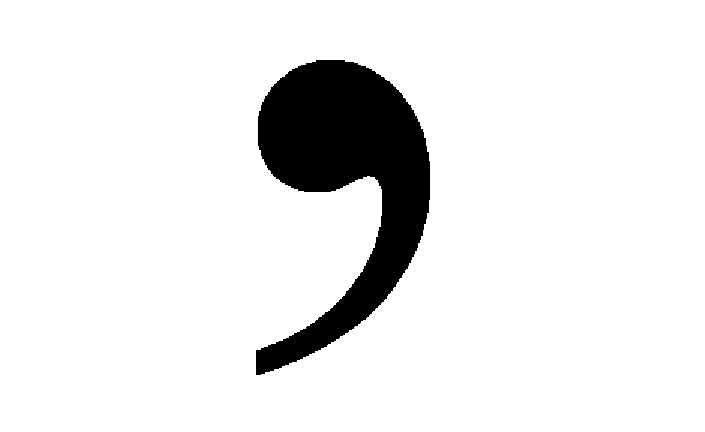
Semicolon

Told you.

This is probably the most misused and misunderstood punctuation marks in the English language. What exactly is it, and what does it do?

First of all, it’s clearly a combination of a comma (,) and a colon (:).

A comma is used to separate elements of a sentence, such as items in a list, or clauses (a clause, generally, is a part of a sentence with its own sentence and verb). Most people use commas correctly without thinking about it, and the rules about them aren’t really strict anyway. Basically, you can use in a comma in a sentence where you would pause if you were speaking. Continue reading

GHOTI

How do you spell fish?

I’ll give you a few seconds to think about it.


*whistles*

*looks out window*

*whistles again*

Ready? Ok, did you say f…i…s…h?

Well, that’s ok I suppose. I mean, it is correct after all.

But wouldn’t you like to try spelling it differently, at least just once? For example, how about… Continue reading

Click

Have you ever walked into a room and forgotten what you went in there for? I do that all the time, and had my first experience of the blogging equivalent tonight.

I don’t plan my blog posts too far in advance. Usually when I sit at my computer, something I’d heard or thought about that day will come to mind, or something that I’ve always thought about will leap out at me.

But sometimes an idea for something to write about will come to me, but knowing I won’t do it that day, I’ll make a note of it, and add it to an ever-growing list of topics for future posts. Occasionally I’ll have a look at this list and choose something to write about. I decided to do that tonight, and one word caught my attention straight away:

Click. Continue reading

Hello

How’s it going?

What’s the story?

Hey!

How are you?

Hi!

What’s up?

How do you do?

What’s the craic?

We have so many ways to say hello, and they vary around the world. We were talking about this in class today (I had one of my infrequent teaching mornings) and it made me think again of the fact that though we have so many ways to greet someone, we actually don’t say hello very often. Continue reading

Revert Back to Me

This phrase is one that’s become increasingly common in business emails in the last couple of years. Basically, it just means get back to me or reply to me. For example:

Revert back to me when you’ve finished the report.

Find out what time they want to have the meeting, then revert back to me when it’s been organised.

It’s part of the strange new world of business jargon: blue-sky thinking, move the needle etc. And while a lot of these short-lived buzzwords can be annoying, revert back to me tends to be the focus of particular anger. The main reason for that is because the word is basically being used incorrectly. Revert means to change to a previous state or action. So for example, someone might revert to a childlike state after a traumatic incident. A werewolf, with the passing of the full moon, might revert to its human state. It’s basically similar to return, but is more specifically similar to transform back. So what someone’s saying when they use revert back to me is transform back into me. Well, I never actually was you in the first place, so that’d be pretty hard! Continue reading

Ooh La La!

In honour of the European Championships being held in France, and specifically the Ireland vs France second-round match this afternoon, I want to look a little bit at the influence of the French language on English. A whole history of this would be exhaustive and exhausting, as there has been a lot of exchange between the languages over the centuries. After the Norman conquest of Britain in 1066, French became the language of the royal court and politics, and remained so for about 300 years, so it’s not surprising that a lot of French words entered the English language.

I’m more interested in words that we’ve taken directly from French, and what they say about our attitudes towards the language as well as French people. The long, long history of antagonism and outright war between England and France in the last couple of millennia has, I think, led to some conflicting feelings about French evident in the way that English uses some of its words. We’ve always had conflicting stereotypes about the French: romantic, sophisticated, with great food and drink, but also rude and arrogant (I’ll just restate that these are stereotypes and not my opinions).

And so we tend to feel that the French language sounds beautiful, elegant and sophisticated, and the areas in which we most commonly use French words reveal a lot about our positive stereotypes about the French. Continue reading

The Oxford Comma

I’ve visited France, Germany and Spain this year.

I’ve visited France, Germany, and Spain this year.

You probably don’t see any difference between the above pair of sentences. But what about this pair:

On Twitter I’m following my friends, Stephen Fry, and Miley Cyrus.

On Twitter I’m following my friends, Stephen Fry and Miley Cyrus.

The second sentence is quite ambiguous. Do I mean that I follow my friends on Twitter, in addition to the celebrities Stephen Fry and Miley Cyrus? Or do I mean to say that Stephen Fry and Miley Cyrus are my friends, and I follow them on Twitter? The latter would probably make for some interesting dinner-party conversations, but that’s probably not what I meant, is it?

Still, just to be sure my meaning is clear, I can use the first sentence, with the comma between Stephen Fry and Miley Cyrus. A comma like this, before the last item in a list of three or more items, is known as the Oxford comma, as it’s an element of the house style of Oxford University Press. There’s quite a bit of debate about whether or not to use the Oxford comma, and it has its strong supporters as well as determined detractors. Some style guides recommend its use, some suggest avoiding it, and others don’t mention it at all.

Why use it? As we see above, it can resolve ambiguity in cases where the first item in a list might seem like it’s referring to the second and third items. More generally, it can avoid ambiguity when two words in a list could be joined together as one item, or could be separate items. For example: Continue reading