Converse

Somewhere online today, I saw an ad or article about Hello Kitty Converse shoes. It probably wasn’t a targetted ad, or else whatever cookies are tracking me don’t know me at all. Curiously, for some reason, when I saw the word Converse, I pronounced it with an emphasis on the second syllable, like it was the verb to converse. Seeing the full title and accompanying picture of course made me realise that the word was Converse, the proper noun referring to the brand name, and not the verb. This was another interesting example of the difference in word stress between nouns and verbs. And of course at this stage, I’d got to thinking: why is the shoemaker named Converse, and how is that related to the verb to converse? Continue reading

Seal Armpit Delivers Inconvenience, Aches

You never what you’re going to find on the internet, do you? I sometimes have a look at the comments on this blog that are marked as spam. Partly because the occasional genuine comment gets thrown in there, but mainly out of curiosity.

Curiosity as to why those responsible might think I’d fall for their obvious tricks, and curiosity about how successful they are. Mostly though, curiosity about the interesting forms of English contained therein. Take this recent comment, for example: Continue reading

Nero Fiddled While Rome Burned

On Saturday afternoon, I decided I felt more like writing (this) while having a coffee in town (apparently the average noise level in a coffee shop is quite inducive to writing), rather than at home, so after wandering around a bit (I had to finish the album I was listening to, of course), I settled on a branch of Caffè Nero.

While queuing, I began thinking about the fact that I’m going to visit Rome next month. I’d always assumed the chain was named after the Roman emperor Nero, and considered that even though they seemed to use a lot of Ancient-Roman style design in their décor, the coffee shop probably doesn’t offer an authentic Ancient-Roman experience. And then I got to thinking about the famous myth that Nero sang and played the fiddle while the Great Fire of Rome raged around him (he probably didn’t: it’s more than likely propoganda spread by the Flavian dynasty that succeeded him).

And then I thought: why do we sometimes call a violin a fiddle? Continue reading

Citizen and Subject

While writing about the word citizen, via denizen recently, I naturally thought of the word citizen in contrast to subject. Naturally, when describing people, they’re quite different. Continue reading

Denizen or Citizen?

I was always fascinated by the word denizen as a child. It’s a word I, unsurprisingly, only ever encountered in writing, particularly in books leaning towards fantasy or science fiction. It was fascinating mainly because I assumed it had to have a very different meaning from citizen. Why else would the writer use the word, when they had the choice to use citizen? Continue reading

Sweet Like Candy

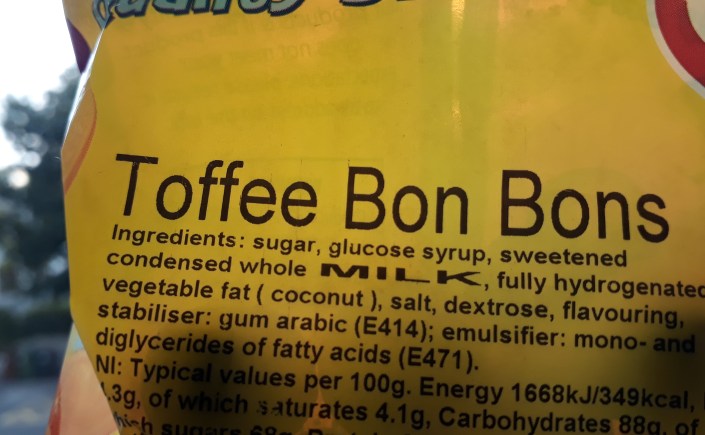
MILK!!

Did you hear me!? I said MILK!!

I had to laugh when I saw this today. I get the idea of course. Milk seems pretty healthy, so why not emphasise that ingredient? If it were the main ingredient, the manufacturers wouldn’t need to do anything, as it’d be listed first (did you know that ingredients are always listed in descending order of how of them much are featured in the product?) Continue reading

Sir, You’re Making a Scene…

I’m currently reading The Terror, an intriguing and aptly-titled novel based loosely on the real-life mid-19th century lost Franklin expedition, which set out to find the fabled Northwest Passage. Franklin refers to Sir John Franklin, the expedition’s leader. Throughout the book, he’s referred to as Sir John Franklin, and after a few times I thought that was interesting because he also of course had a naval rank, which could be used alongside Sir. But would it come before or after Sir? Continue reading