It Started with a “This”

This evening, while cycling home from work, a thought occurred to me. A slightly panicked thought. I recalled that in my post yesterday I’d linked to an article, and I thought…

 Did I include the link!? (Clearly my cycling thoughts aren’t as interesting as my running thoughts. I suppose I’m too focussed on the road)

You see, rather than write my post directly on my blog, as I usually do, yesterday I’d written it as a word document, as I wasn’t online at the time, and then copied it onto the blog later. And then of course I included all the links. Or did I? Because it would be very easy to forget to (spoiler alert: I didn’t). Before I got home and put my mind at ease, I felt a little annoyed. If I had forgotten it, how stupid would that look? It would be so obvious I’d forgotten the link, and it would be unfortunate for anyone reading it, as they’d miss out on what was a very interesting article. But then, another thought occurred to me: would that actually be so bad?
Continue reading

The Beauty of a Circle

While I was running this evening, and my mind was wandering, I thought about the phrase a nice round number. I wondered to myself why we call them round numbers. And then almost straight away I answered my own question and said that it’s obviously because of the zero. Which is round. And round numbers always end in a zero.

Well, that’s that. Sometimes the answer is just that simple, and I’m even able to figure it out myself. Not that that stopped me thinking about numbers, and roundness of course.

Continue reading

Ten Amazing Facts about the English Language (No.7 Will Shock You!!), or: The Art of Clickbait

Read on to find out some of the most amazing facts about the English language! Facts such as…

Continue reading

Roaming Charges

On Thursday 15th June 2017, roaming charges were abolished within the EU. And there was much rejoicing. Roaming charges were one of those things that for a long time I kind of just accepted. Living in Ireland, the rest of Europe usually felt far away enough that it seemed somehow appropriate that using my phone would be more expensive whenever I went there. But recently I drove for about 45 minutes from Belgium to the Netherlands, and suddenly it seemed entirely absurd that I had to pay a fortune (rather than nothing) for using data, just because I’d crossed a fairly arbitrary line. Why should it cost more in a different country? Was I inconveniencing the phone company in some way? Did they have to do more work to drag the data over the border and into my phone?

Continue reading

Bloomsday

Today is Bloomsday, which is perhaps not the best-known day of celebration. It’s a celebration of all things James Joyce, and more specifically, his great novel Ulysses (1922). Bloomsday always falls on 16 June, because that’s the day on which the book is set (in 1904). And it’s named Bloomsday in honour of the novel’s hero, Leopold Bloom. And of course his wife Molly Bloom too, who has a very important part to play in the book. Why though, would we have a day of celebration for a single book?

Continue reading

Hacked!

The verb to hack, in a computer-related sense, has been around since the 80s, though it seems to be more prevalent recently, thanks mainly to the hacking scandals surrounding last year’s American Presidential Election, as well as the many less important scandals which pop up on the news fairly regularly. It’s not surprising really that nowadays, hacking is synonymous specifically with computer hacking, given how integrated computers are into every aspect of life.

Of course you’re probably aware that that’s not the original meaning of the word.

Continue reading

The Passive Voice

Let’s imagine you’re writing an essay about your favourite writer. You might decide to begin by mentioning your favourite of his books, like so:

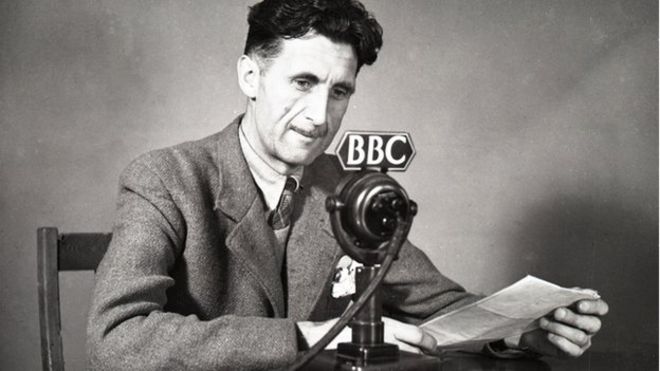
George Orwell wrote Nineteen Eighty-Four in 1949.

Now, let’s imagine you’re writing an essay about your favourite novel. A logical start would be to mention who wrote it, like so:

Nineteen Eighty-Four was written by George Orwell in 1949.

What’s the difference between these two sentences? I’m sure you’ll agree that both contain the same information. But the focus is different, isn’t it? In the first we’re focussing on the writer, and in the second, on the novel. And we change focus by changing focus – between the active voice and the passive voice.

Continue reading