
About a day before the time of writing, President Donald Trump, of the United States of America, said the following, in relation to meddling in the 2016 election:
Wouldn’t it Be Nice?

About a day before the time of writing, President Donald Trump, of the United States of America, said the following, in relation to meddling in the 2016 election:

You may have said this today, in frustration perhaps, or in anger. Maybe it wasn’t quite as long as that. Maybe it was just a quick, cathartic Argh! I’m sure it’s something we’ve all said at least a few times in our lives. Did you ever wonder why it’s spelled in such a strange way though? Continue reading

I was enjoying some French conversation last night, on Bastille Day, when someone tried to think of the French translation for sensible. This is a tricky one because there is a French word sensibilité, but it’s a common false friend for French speakers, as it actually means sensitive in English.
That might seem odd to you, because sensible and sensitive are quite different in meaning in English. However, if we take a little trip into the past, we can see that the difference wasn’t always so marked. Continue reading

I heard this phrase this afternoon, and thought, Well, there’s no great mystery with this one. Red-handed refers to having blood on one’s hands from an act of murder or some other violence. No complicated, confusing web of etymology here.
But then I thought, I always think that, and then I look something up and there’s a fascinating, unexpected origin of the expression that I’ll be excited to share with you, dear reader. Continue reading

I know this one! I hear you say. -ise is British English, and -ize is American English. That’s it, isn’t it?
Basically yes, but also no, not really. Continue reading

Football’s not coming home after all then. In fact, it’s probably going to France. Plucky England did very well to get to the semi-final of the World Cup, and they can be proud of getting so far, and working so hard, with a fairly limited team.
Well done England, but also, commiserations. Continue reading
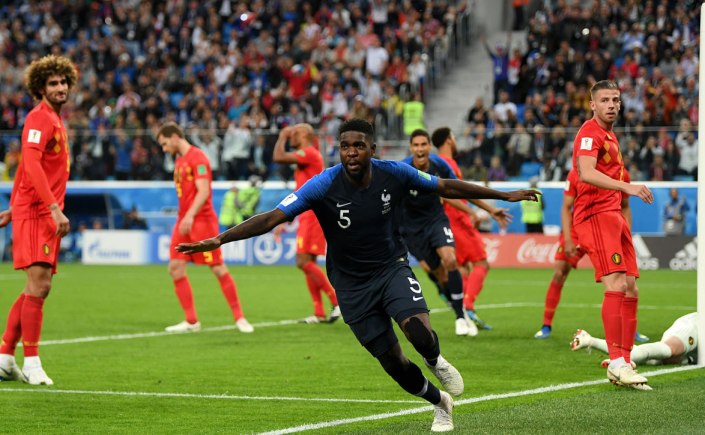
Yesterday on Facebook, I wrote briefly about the French phrase tenir la chandelle (literally to hold the candle), which means to play gooseberry. This got me thinking a little about the French verb tenir, which then led me to think about how it relates to the French word maintenant.
And yes, this is all about French, but in honour of France qualifying for the World Cup Final tonight*, I thought it was time for a little change of pace, and some French-Language Thoughts!™ Continue reading
 English-Language Thoughts