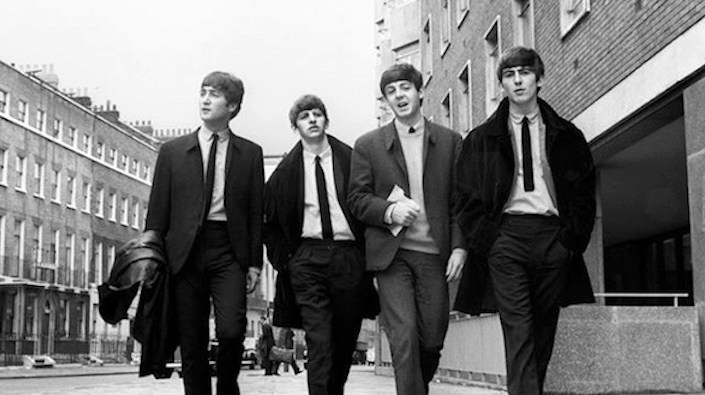
The Beatles: Here Comes the Pun

The Beatles are responsible for a lot, of course. Producing some incredible and innovative music, and inspiring other musicians. They’re also responsible for causing people to misspell the word beetle (as in the insect). As a spelling nerd from a young age, I was long aware that the band’s name was spelled differently from the animal. I never really thought about why though. I suppose I assumed that The Beatles could do whatever they wanted, and that if they wanted to spell their name differently, that was fine. Or maybe that’s how they thought the word beetle was spelled, and who was I to correct them? Continue reading

Lady Mondegreen

Ireland’s industry

There’s a bathroom on the right

Excuse while I kiss this guy

What do these statements have in common? They’re all mondegreens. What’s a mondegreen, you ask? Let me show you…

Ireland’s industry – Islands in the stream (Islands in the Stream, Dolly Parton & Kenny Rogers)

There’s a bathroom on the right – There’s a bad moon on the rise (Bad Moon Rising, Creedence Clearwater Revival)

Excuse me while I kiss this guy – Excuse me While I Kiss the Sky (Purple Haze, Jimi Hendrix)

A mondegreen is a misheard song lyric. The unusual-sounding word was coined by American writer Sylvia Wright in 1954 when she wrote about how she misheard the line …and laid him on the green from the 17th-century Scottish ballad “The Bonnie Earl of Moray” as …and Lady Mondegreen.

I’m quite fond of mondegreens, simply because they can be very funny, but they’re also a great leveller. No matter your mastery of the English language, the rhythms of song lyrics and the accompanying make it often quite hard to heard lines correctly. Plus, we tend to expect language to follow familiar patterns, so it makes more sense to our brains to kiss a guy than kiss the sky. (It’s also only fair to point out that in normal conversational connected speech, Excuse me while I kiss this guy and Excuse me while I kiss the sky sound identical.)

We all have our own mondegreens. The one I always remember from my youth is Prefab Sprout’s “The King of Rock n’ Roll.” I always thought the line Hot dog, jumping frog, Albuquerque was actually Hot dog, jump in fire, how about turkey? Which I think works equally well. I also thought the Transformers jingle proclaimed them to be robots in the skies, as opposed to in disguise. It never made sense to me, because only some of them could fly.

I was surprised to discover that the most-commonly misheard line, according to a British survey was Call me if you try to wake her up from R.E.M’s “Sidewinder Sleeps Tonite,” which people mishear as Calling Jamaica. It kind of fits I suppose, but you really need to stretch it! I would have thought Haddaway’s “What is Love” (When You Don’t Hurt Me instead of Baby Don’t Hurt Me) would be more common, or Abba’s “Waterloo” (How does it feel to have won the war? instead of I was defeated, you won the war).

What are some of your mondegreens?

Hey Baby!

Baby One More Time

Be My Baby

Baby I Love You

Baby Blue

Baby Baby

Baby It’s You

Baby Boy

Baby Come Back

…and so on. Why is baby (or babe) such a romantic word, that it would be featured in so many song titles like that? We’re so used to it, but if you step back and think about it, it’s a bit strange. There’s no obvious connection. Austrian ethnologist Konrad Lorenz suggested that babies’ cuteness was an evolutionary advantage, providing an incentive for adults to look after them. He believed that men sought similar signs of attraction in women, such as large eyes. Men calling women baby would therefore be a sign of this attraction. That seems a bit too easy though. Even if such an attraction did exist, it would be subconscious, so it would be unlikely that men would consciously refer to women as baby for that reason. And of course now baby is used across genders, though that’s probably more a sign of increased gender equality. Continue reading

What a Drag it is to See You

You might have noticed that Bob Dylan was awarded the Nobel Prize for Literature on Thursday, for “for having created new poetic expressions within the great American song tradition.” Some people have expressed surprise at this, feeling that a lyricist shouldn’t be given the award. I don’t see why not though. First of all, there’s not such a difference between poetry and song lyrics. They’re very similar structurally, tending to be divided into verses, and share the same concerns with rhythm and rhyme. I think some people feel that because song lyrics need to match the song’s music, they’re therefore less important than less important than the words of a poem or a novel which the writer was not required to match to anything. But I don’t think that’s much of an argument: all that should matter is the words, and if they’re good, and can be appreciated on their own, without music, then why shouldn’t that count as literature?

Anyway, to celebrate Bob’s win, here are some of my favourite of his lyrics in no particular order, and without commentary, because sometimes I just like them for their own sake: Continue reading

How to Disappear Completely

21st June 1997, Dublin, Ireland:

Touring their hit album OK Computer, Radiohead play in front of 33,000 fans at the RDS arena. Terrified at having never played in front of such a big crowd before, lead singer Thom Yorke later has a nightmare in which he imagines himself naked, floating down the River Liffey and being pursued by a tidal wave. This dream inspires the song “How to Disappear Completely,” which appeared on their following album, 2000’s Kid A. The song is a slow, melancholy, beautiful one, and very personal, dealing with the mental breakdown Yorke suffered after the critical and commercial success of Ok Computer. It directly refers to Thom’s dream in the opening verse: Continue reading

Freak out in a Moonage Daydream (Oh Yeah!)

David Bowie’s been in the news a bit recently, with his final album Blackstar having been nominated for the Mercury Music Prize, and a new play featuring his music set to debut soon. I loved his music, even though I only really started to listen to it in my twenties. I was quite sad when he died, and the world still feels like a more boring place without him. Continue reading

My Baby Don’t Care for Shows…

My love don’t cost a thing.

She don’t love you (like I love you).

If you don’t understand him, an’ he don’t die young, He’ll prob’ly just ride away.

She don’t know.

He don’t deserve you anymore.

She don’t let nobody.

She don’t like the lights.

Your inner (or, indeed, outer) grammar pedant may have cringed at the recurring word in the lyrics and song titles above: don’t.

Doesn’t! that shrill little voice inside shouts, doesn’t!!

Continue reading