Son of a Bitch

Yeah, I mean, I don’t want to get too political. Every Tom, Dick, and Harry’s got their hot take on Donald Trump, so I want to keep things focussed on language: grammar, etymology, stuff like that. Hang on, let me just have a quick look at Twitter before I write… He’s said what!?…

On Friday, Donald Trump, somehow President of the United States, weighed in on the controversial issue of professional American-football players protesting against racial injustice and police inequality towards African Americans. He naturally employed all the gravitas and diplomacy one would expect of his office, and said the following:
Continue reading

Calling a Nazi a Nazi

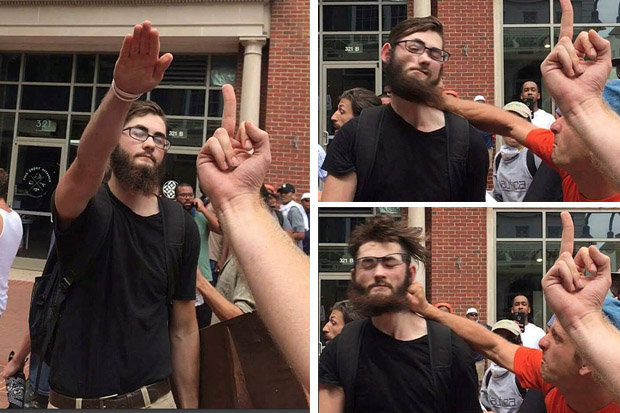
Following the violence (from armed Nazis, and the one side they represent) in Charlottesville, some people have suggested that the perpetrators only acted like brutal, thuggish Nazis, because people had been calling them brutal, thuggish Nazis for so long. Of course they’re going to act like Nazis if you keep calling them Nazis! Obviously it’s an attempt to take the blame away from the actual Nazis committing the violence. It’s an attempt to say, Look, these are just troubled young men not happy with the way they’re country’s going. But they’ve been demonized by SJWs, and that’s made them lash out in frustration! What do you expect when you call someone a Nazi!

There a couple of assumptions being made here. The first is that if you label someone with a negative name often enough, they’ll become what you call them. And that seems logical enough. Imagine how angry it would make you to unfairly labelled as something as terrible as a Nazi!? Except, that only really works when the label is applied unfairly, doesn’t it? So let’s take a moment to have a look at some of the people being called Nazis:

Continue reading

Just How Bad is Donald Trump’s English? (Putting him to the Test)


It’s easy to say that Donald Trump has poor English. It’s easy to say that the level of English that he uses, in terms accuracy and tone, is far below the minimum expected of any public speaker. And of course the reason it’s so easy to say these things is that Donald Trump actually has really bad English. So inspired by a colleague’s idea, I’m going to test him, to see exactly what level of English he has. Specifically, I’m going to assess Trump’s spoken English using the assessment criteria of the spoken section of the IELTS exam.

Continue reading

“Grab them by the…”

…hand? Or, whatever you want really, but again, like yesterday, you can imagine that I’m thinking of something else. Because yesterday I got a good firm grasp of how we use synonyms for penises as insults, now I want to do the same thing from a female perspective. Well, not really from a female perspective I suppose.

Continue reading

Roaming Charges

On Thursday 15th June 2017, roaming charges were abolished within the EU. And there was much rejoicing. Roaming charges were one of those things that for a long time I kind of just accepted. Living in Ireland, the rest of Europe usually felt far away enough that it seemed somehow appropriate that using my phone would be more expensive whenever I went there. But recently I drove for about 45 minutes from Belgium to the Netherlands, and suddenly it seemed entirely absurd that I had to pay a fortune (rather than nothing) for using data, just because I’d crossed a fairly arbitrary line. Why should it cost more in a different country? Was I inconveniencing the phone company in some way? Did they have to do more work to drag the data over the border and into my phone?

Continue reading

Using Apostrophes and the Future of English in Europe

English has long been fashionable to use in other languages. For teenagers and young adults, it’s the language of a lot of their pop culture, as well as being an international lingua franca, that can help one connect with people all around the world. That’s why, especially across Europe, you’ll find little bits of English peppered throughout people’s speech.

Naturally, this isn’t always going to be accurate in terms of native speakers’ usage, but that’s not so important. I’ve noticed recently though, an apparent trend in how non-native speakers use English that’s a little bit curious, because it reflects one of the ways in which native speakers make mistakes in English.

Continue reading

Ban

I suppose I should answer the question I started with yesterday: When is a ban not a ban?

The answer of course, is: when it’s not a ban. Continue reading