Mario

Mario is, obviously, a very common Italian name. It struck me the other day though, that it’s curious that it’s a male equivalent of Maria. And Maria of course, has an English equivalent in Mary, but there’s no English form of Mario.

Continue reading

Temple

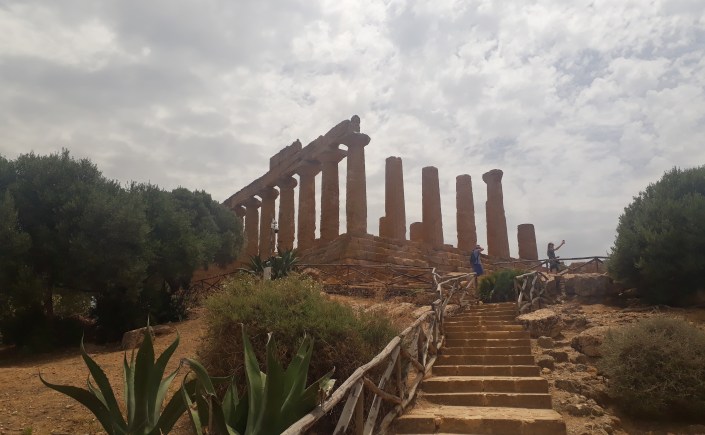
I’ve spent the last two days in Agrigento, a town on the south coast of Sicily, and close to an impressive Ancient Greek temple complex known as the Valley of the Temples. While on my way there, I wondered: why do we call the areas to the side of our forehead temples? Continue reading

My Genial Friend

I came across an interesting false friend recently, when a student referred to a person as genial. Now, this might seem fine to me, but is was clear from the context that a word like brilliant would have been more appropriate. How can we explain this seemingly strange error, confusing two such obviously different words? Continue reading

You’re Unfriended, Amigo!

Or perhaps enemigo would be more appropriate!

I’m not an expert in Spanish by any means. But recently I found myself watching a brief clip from Toy Story 3 (I can’t for the life of me remember the context, but it was a YouTube video of some sorts). The clip was from when Buzz Lightyear’s accidentally had his voice (and personality: I have seen Toy Story 3) changed to Spanish. From this very brief clip, and memory of watching the film, I recognised that he was saying Are you a friend or an enemy!? Which was very interesting. Continue reading

Let the Negotations Begin

I discovered an interesting bit of etymology recently. I was reading SPQR: A History of Ancient Rome by Mary Beard. In a chapter about work and business, she mentioned a Latin word  – otium. Continue reading

Ph or F?

Have you ever wondered why both F and Ph can have the same sound in English?

Phone, philosophy, Philadelphia: force, far, fair etc. Continue reading

Quite a Predicament

I saw the word predicament recently, and thought that it would be an interesting case for a little bit of etymology figuring-out. It looks so Latin, with such clearly separate sections, each of which could have its own meaning, and which could all be added up to clearly show the meaning of the word as whole. Continue reading